Interview Identity 4/8 – Pretender

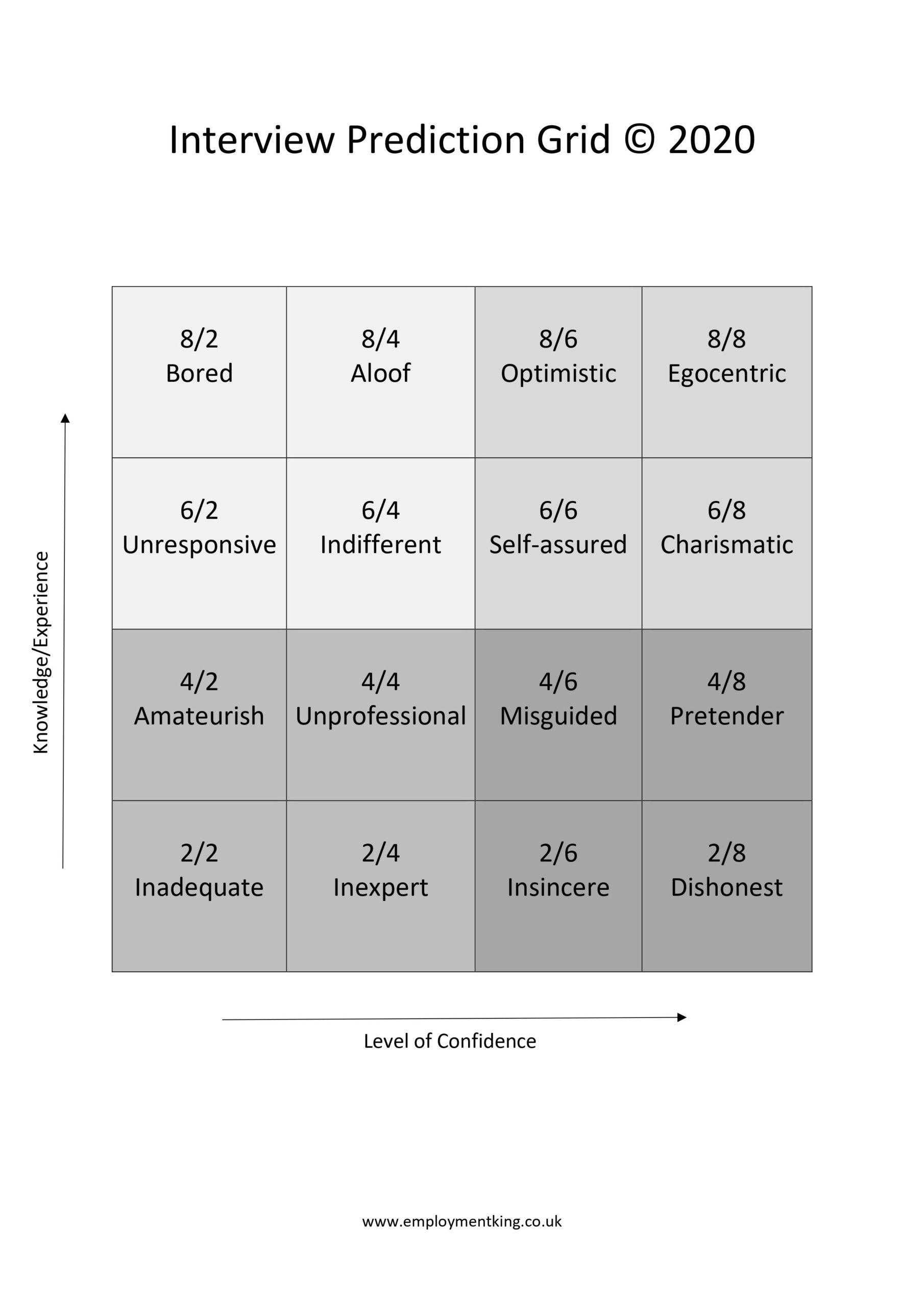
Congratulations on completing the Interview Prediction Grid Test (IPG) ©2020.

Below is a breakdown of your Interview Identity

4/8 – Pretender

pretender interviewee

Self-assurance increases self-promotion. There is a fine line between being viewed as highly confident and being overbearing. 

The 4/8 – Pretenders believe they should be offered the position, as they possess a sufficient level of knowledge/experience and, due to high levels of confidence (or in most cases overconfidence) believe they can learn what they don’t already know. 

For high to medium skilled positions, employers are looking for a deeper understanding of industry insights that most sufficient levels of knowledge/experience candidates don’t possess. The high levels of confidence increase self-enhancement, with 4/8 – Pretenders downplaying their own limited knowledge and criticising others to be viewed, by comparison, as more skilled. 

Being overconfident in the correctness of their answers can ruin the applicants’ job chances, especially if the interviewer is an expert in the field. Expert interviewers will challenge any ambiguous statements they believe to be false. Self-absorbed applicants, preoccupied with their own self-importance, won’t back down on their (potentially incorrect) opinion.

Against other low/high applicants and for low-skilled roles, the 4/8 – Pretender will often be triumphant in the job interview. Against confident interviewees with more industry knowledge, they are unlikely to be successful. 

The 4/8 – Pretender, when applying for medium-skilled positions, will claim to know more about the role/sector without being able to back this up with evidence. A trained interviewer will spot the lies through the structured interview process, but an inexperienced interviewer may be duped, due to the candidate’s assertiveness and presence, into recruiting a lesser skilled staff member than they are expecting. 

Strengths 

Job interview success comes from following job interview rules 2 and 3; self-promotion with confident communication, something 4/8 – Pretender interviewees has in abundance. Their high level of confidence creates a strong identity of self. Believing in one’s own knowledge/experience increases the positive frame of any job interview answer. 

Interviewers, when meeting a highly confident interviewee, can quickly be in awe of the applicant, as charming and relaxed people are viewed as powerful, charismatic. With no inhibitions, self-assured individuals will make it clear what it is they can bring to the team, reciting stories that make them the hero. Even with a cold interviewer, the authoritative attitude carried throughout the interview wins the hardest to please people around. 

Being skilled in the art of confident communication leads to a persuasive manner, which helps when being challenged on past experiences. Questions that allow applicants to discuss any strengths or successes lead to a powerful and enthusiastic answer that expresses how they, and only they, have the unique talent required for the advertised position. 

In unstructured job interviews, interview presentations and at any time when they are in the limelight, being at the top of the confidence scale allows these applicants to showcase all they have to offer, often leading to high-scoring answers. 

Development

Highly confident individuals have no qualms about expressing how they will succeed in their career. This self-belief is a knife edge between being seen in awe, or as a potentially awful employee.

Having an inflated view of one’s own worth results in applicants applying for higher-skilled roles before they have gained the relevant industry knowhow. 

In some instances, the charming effect created because of high levels of confidence along with sufficient knowledge/experience is enough to land the desired job role. Expert interviewers, even though the initial impression was positive, will, in the main, give low marks as the 4/8 – Pretender’s answers lack expertise. In addition, technical questions have no substance as these applicants have little experience dealing with problems that sit outside of their own area of knowledge. 

Increasing the level of knowledge and experience is relatively easy for a ‘8’ confident applicant, as they can easily persuade senior colleagues to let them be a part of a new project, gaining valuable transferable skills and that all important required knowledge and experience. 

Many 4/8 – Pretender interviewees also have to learn not to oversell themselves at the interview start. Instead, the applicants can focus on their actual experience and how their knowledge will make a positive impact on the organisation (sell what you know). In addition, any research into the new role will improve their interview performance, as an ‘8’ confident level interviewee is at ease talking about subjects they have read up on.

Advice for the job interview

  • Assess the job criteria against actual experience. Deliver engaging stories that focus on added value, highlighting sector-related strengths and qualities to increase high scoring answers
  • Use known industry jargon throughout the job interview and build upon any industry facts or data the interviewer presents. This will improve the perceived level of sector knowledge 
  • Break down processes into a step-by-step explanation as the number of words per answer increases the points awarded to the interview answer

Research: IPG

Evolve the mind book on Amazon

Interview Identity 4/6 – Misguided

Congratulations on completing the Interview Prediction Grid Test (IPG) ©2020.

Below is a breakdown of your Interview Identity

4/6 – Misguided

Misguided interviewee

The interview process is designed to uncover the interviewee’s strengths and weaknesses, through a series of questions. 

With a sufficient level of experience/knowledge, the 4/6 – Misguided applicant can often believe, due to the medium confidence level, that they are entitled to a higher-level position. This belief is unwarranted, as many other interview identities possess the same or a higher level of confidence, along with a higher level of expertise. 

Those 4/6 – Misguided interviewees feel confident as they may have had previous successes winning low-skilled positions against weaker candidates. This is because a medium level of confidence results in stronger self-promotion than that of a sufficient confident applicant. But employers recruiting medium-skilled workers demand a particular set of essential criteria. 

It is often the lack of ability to identify the job criteria, and therefore present the relevant skills embedded within the job interview answer(s), that is the downfall for a 4/6 – Misguided applicant.

Strengths

For low-skilled positions, 4/6 – Misguided candidates are likely to gain offers of employment when applying for roles that match their current level of knowledge/experience. The ability to speak with authority on subjects they are very familiar with, increases the employer’s respect resulting in high scoring answers. 

When discussing past experiences, communication is strong with answers being well-structured and to the point. The delivery style is also good, as confidence improves diction, pace, vocal variety, and emotive language. 

The medium level of confidence results in the use of relevant stories and examples, not just stating facts as a low confident interviewee would. This storytelling creates intrigue and interest, often scoring high as research tells us that a high number of words per answer increases interview points. 

Interview presentations also scored high as applicants have ample time to prepare in advance, helping them to be seen as more knowledgeable than they actually are. During the presentation itself, they come across as highly competent as they feel at ease being in the spotlight. 

Development

Having some industry experience and/or sector-related qualifications is enough to answer a few technical questions, but not enough to be viewed as an expert. 

The medium level of confidence can create an unrealistic self-identity, where 4/6 – Misguided interviewees believe they will be offered the job role. The scoring system of a structured interview can become their undoing with answers scoring low due to missing criteria. 

For promotional roles – attempting to gain work in medium-skilled positions, many of the competition will have higher level qualifications and therefore a greater understanding of sector theories and models. A longer period of direct experience helps a competitor feel competent when challenged on industry related problems. 

It is when challenged or asked to discuss a concept that the 4/6 – Misguided interviewee is unfamiliar with that causes a decrease in confidence, resulting in a weak answer. 

Requesting to be part of a team working on a new project in their current place of work, or to be mentored by a senior staff member can help to increase knowledge/experience improving the perceived ‘interview identity’. Learning from experts can be an educational shortcut. 

Gaining a degree level qualification increases knowledge of sector-related models and theories, helping applicants to answer questions where they lack actual work experience.

Advice for the job interview 

  • Utilise self-debate to give a detailed answer by discussing the advantages and disadvantages the underlying skill or knowledge the interview question references 
  • Explain sector-related theories and models relevant to the job role in question. Break these down into specifics as this will help you come across as knowledgeable
  • Increase self-promotion; focus the main section of an interview answer on the added value you can bring to the team

Research: IPG

Evolve the mind book on Amazon

Interview Identity 2/8 Dishonest

Congratulations on completing the Interview Prediction Grid Test (IPG) ©2020.

Below is a breakdown of your Interview Identity

2/8 Dishonest

Dishonest interviewee

Possessing the highest level of confidence and the lowest level of knowledge/experience increases verbal diarrhoea. The distance between the two axes; low knowledge/experience and high levels of confidence, sends off warning signals to the employer, creating the feeling of distrust. 

The 2/8 – Dishonest interviewee will answer interview questions quickly, assertively and confidently to cover up a lack of knowledge/experience. But this approach can come across as false, especially if the applicants state confidently that they possess a skill/experience that they don’t have. 

As we have discussed, self-promotion and rapport building influence the job interview, and hiring decisions are often based on initial impressions. With this in mind a 2/8 – Dishonest interviewee can be viewed, initially, to be more employable than they actually are, especially if the interviewee isn’t an expert. 

Often, overconfident interviewees will believe that they will be an asset to any organisation. Without a higher level of expertise, it is unlikely, but not impossible, that they would be offered any position above a low-skilled role. This comes down to the scoring system of the structured job interview. 

Strengths

Everything about the applicant oozes confidence: relaxed posture, warming smile, and a natural ability to make other, more senior career professionals, ask for their opinion. Even the candidate’s outfit, walk and tonality create the impression of a self-assured individual.

Often, when going to meet the interviewee, the interviewer will find the candidate having a relaxed conversation with the receptionist, helping to create a positive first impression. Once the employer introduces themselves, the confident applicant will give their full attention to the interviewer; strong eye contact, a powerful handshake and a confident introduction, all help to build the feeling of trust from the outset. 

In the interview, it will often be the interviewee, not the interviewer, who will generate small talk, finding common interest to discuss. This ability to create rapport with everyone they meet, reassures interviewers that they offered the interview appointment to the right candidate.

Each interview answer is delivered using stories and anecdotes, creating interest in the interview panel. When listening to the interviewers, the 2/8 – Dishonest interviewee will nod along and agree with their comments and ideas, using the ‘if I like you, you will like me’ psychological process for rapport building.

Development 

The high level of confidence can be enough to win some employers’ trust, increasing job offers, but this really depends on which type of low-skilled position the applicant is applying for. 

In the main, employers require a level of knowledge and experience for an interviewee to be successful. As the interviewer questions overconfident applicants on their understanding of the job criteria and their sector knowledge, rapport starts to break down. 

The employer has expected the candidate to be an industry expert or at least to have a medium level of knowledge and experience, presumed through the candidate’s high level of confidence. The nodding and agreement with the interviewer’s points, from the candidate, would be viewed as having similar opinions (a likeability factor) but as the falsehood is uncovered the interviewers will feel that they have been deceived, breaking rapport and seeding distrust.

What is needed here, is an understanding of the job criteria (rule 1 of a successful interview) to help form a structured interview answer. Even with a list of criteria it can be hard for a low level of experience applicant to state enough relevant knowledge/experiences to gain high-scoring interview answers. 

To overcome this obvious barrier the job hunter needs to gain an industry related qualification and/or sector experience. Gaining even a minimum understanding of a sector and having industry-related work experience, when combined with a high level of confidence can result in accelerated career advancement.

Being able to show understanding of an industry, along with a high level of confidence is enough to be seen as credible and likeable: a winning combination.

Advice for the job interview 

  • Agree, rather than disagree, if an employer picks up on any industry related errors discussed during an interview answer. To avoid confrontation, use an agreement frame, “Yes, of course you are correct, what I meant to say was …”
  • Promote your high level of confidence as a specialised skill, backing this skill up with other valuable, industry-related, qualities
  • Generate a conversation. Ask additional questions, and give the employer your full attention as this generates a powerful level of likeability

Research: IPG

Evolve the mind book on Amazon

Interview Identity 2/6 – Insincere

Congratulations on completing the Interview Prediction Grid Test (IPG) ©2020.

Below is a breakdown of your Interview Identity

2/6 – Insincere

insecure interviewee

Confidence is an advantage in a job interview, as referred to in the high/high segment. However, when combined with low knowledge/experience, the increased self-assurance can be seen as hollow – you talk the talk, but can you walk the walk? 

Often, medium confident individuals will make up for their lack of knowledge/experience by increasing verbal communication without making reference to the job criteria, confusing the interviewer. 

Unlike their high confident counterparts, who can use their personas to influence the interview outcome with a non-expert interviewer, the 2/6 – Insincere interviewee doesn’t have the required level of confidence to sway the interviewer’s opinion. This is because the lack of knowledge/experience puts the applicant on the back foot. 

Depending on the interviewer, the medium confidence level can be enough to secure some job offers above the low-skilled job level, but in most cases, the lack of expertise results only in low-skilled positions.

Strengths

Initial impressions are often strong with a 2/6 – Insincere as they present well and speak with authority on subjects they know well. This rapport building ability puts the interviewer at ease. 

Confidence increases self-promotion. If the applicants are proactive, spending time researching the job criteria, they can design and practice high scoring answers. 

Repeating well-rehearsed skill-based answers and using any known industry jargon can give the impression of having a higher level of knowledge/experience than they have. Only when challenged by an expert interviewer, do these applicants lose their ability to sell themselves. 

On non-technical interview questions and during informal job interviews the 2/6 – Insincere applicant does well. When asked specific sector-related questions they are likely to fail in their attempt to impress the recruiter.

Development

Expectations are high after an initial positive introduction. It is the contrast of a perceived high level of knowledge/experience assumed by the employer due to the applicant’s confidence level, and the actual truth, which is often uncovered during technical questions, where the insincere identity is created. 

Having virtually no industry-related experience is the barrier here. For voluntary positions the medium confidence level is enough to get a foot in the door. For low-skilled roles, employers are looking for a minimum level of related knowledge or experience which could be gained quickly through voluntary opportunities and/or educational pathways.

To improve this area of weakness, gaining an industry related qualification will not only allow them to understand industry-related jargon, they will also possess practical understanding of how to implement sector models or theories into business as usual tasks.

In addition, understanding the job criteria, industry jargon and commonly used processes can help. In the main, to gain a paid position where actual work experience or a related qualification is required.

Advice for the job interview 

  • Pick and research an industry-related news story prior to the job interview. Discuss with the employer before the interview start, as this will seed the idea of the applicant being knowledgeable – the halo effect 
  • Talk in depth about familiar sector-related topics, using well-known industry jargon when possible 
  • Reference the job criteria using non-work-related examples (or work-related examples if you have these). Personal stories can be utilised to highlight relevant skills and qualities.

Research: IPG

Evolve the mind book on Amazon

Interview Identity 4/4 – Unprofessional

Congratulations on completing the Interview Prediction Grid Test (IPG) ©2020.

Below is a breakdown of your Interview Identity

4/4 – Unprofessional

Out of all the low/low identities, the 4/4 – Unprofessional interviewee is the most likely job applicant, in this segment, to be offered a paid position. But, compared to other applicants from the additional three segments, the 4/4 – Unprofessional applicant will be seen as a weaker candidate. 

The employer will be aware of the 4/4 –Unprofessional applicant’s knowledge/experience level as the candidate has a sufficient level of confidence that allows the interviewee to give a more detailed reply to job interview questions. This detail allows the interviewer to gain an understanding of the candidate’s strengths and weaknesses. 

In most recruitment campaigns, a 4/4 – Unprofessional interviewee will be seen as below the required level of standard for paid employment. For some large recruitment drives and/or for large organisations or voluntary employers, who have the time to support a new recruit, the 4/4 – Unprofessional interviewee can have a successful interview outcome

Strengths 

The combination of the sufficient knowledge/experience and confidence shows potential. It is the competition, which possess a higher level of knowledge/experience and/or level of confidence that are more likely to be offered the paid position. 

Being in possession of several soft skills makes the 4/4 – Unprofessional applicant suitable for several potential career sectors. It is sometimes a lack of career focus that creates this identity. The ‘interview identity’ can change once the interviewee has a defined career objective, as the new focus creates more relevant interview answers referencing the required skill set. 

The confidence to talk about previous experiences allows employers to gain an understanding of the candidate’s work ethic. This is key for employers who are looking to recruit applicants to fit in with their company culture.

As there is a lack of challenging questions for voluntary, and some low skilled positions, the sufficient level of confidence allows the interview, in the main, to run smoothly.

Development 

Initially, a reflection on the applicant’s interview performance is required to identify the key area of development; perceived knowledge/experience or level of confidence. By working on whichever criteria is weakest can change the perceived ‘interview identity’. 

Developing a criteria (skill, knowledge or experience) that is deemed by the employer to be important can move the perceived level of knowledge/experience from sufficient to medium. 

For voluntary positions, the barrier to employment could be the lack of a qualification, e.g. a forklift truck licence certificate for a warehouse role or for higher skilled positions, becoming an expert in, as an example, algorithms for IT positions. 

Having sufficient confidence, with an increase in knowledge/experience can be enough for candidates to progress up the career ladder. 

Experience within a sector, even if this means working at a low-skilled job for a number of years, improves the chances of applying for promotional positions. The duration in a field creates familiarity with industry jargon, sector models and industry processes. 

It is the sufficient confidence level that creates the unprofessional identity of a 4/4 interview identity. More self-assured applicants naturally utilise rule 2 and 3 for a successful interview outcome; they are confident self-promoters. 

To improve confidence, the 4/4 – Unprofessional needs to become aware of the volume of self-disclosed weaknesses (a common practice for this interview identity). In addition, showing eagerness, interest and a passion for the industry and job role changes the employer’s perception of the candidate.

Confidence can be developed through taking classes such as public speaking or improvisation and through mock job interviews, to help refine the interview answers.

Advice for the job interview 

  • Focus interview answers on strengths and successes. If a weakness is self-disclosed, explain what was learned from the experience not the weakness itself 
  • Ask for specifics for any ambiguous interview questions to ensure that the answer meets the criteria for that particular question
  • Allow natural hand gestures throughout the interview to reinforce verbal-communication and to be viewed as confident 

Research: IPG

Evolve the mind book on Amazon

Interview Identity 4/2 – Amateurish

Congratulations on completing the Interview Prediction Grid Test (IPG) ©2020.

Below is a breakdown of your Interview Identity

4/2 – Amateurish

The 4/2 – Amateurish interviewees may highlight their sufficient level of knowledge/experience (at this level of job role, the knowledge/experience includes soft skills: communication, teamwork, problem-solving) during the job interview question-and-answer process, but each answer is delivered in an unskilled way, due to a low level of confidence. 

The employer will get the gist of the meaning of the answer but, depending on how the answer has been delivered (often lacking substance), the meaning will often be misunderstood creating the impression of amateurish. 

A cold interviewer will further reduce the applicant’s confidence which can result in a poor interview performance.

Strengths

Possessing the required soft skills for voluntary, and possibly low-skilled positions, increases the chances of a job offer. For some 4/2 – Amateurish applicants they may even possess a unique skill that would make them highly desirable, once they have gained the confidence to promote their expertise. 

Many introverts, not that introvertism equals low confidence, are geniuses, or highly skilled, but job offers are awarded to the candidates who follow the second rule for a successful job interview – being a self-promoter. 

Those 4/2 – Amateurish will either have sufficient soft skills suitable for a position up to a low-skilled job role or perhaps possess a higher level of knowledge/experience that they struggle to express in the confines of a job interview environment.

Development 

A structured interview answer increases the perceived level of confidence. As does pausing during interview answers, reducing the use of filler words and improving eye contact. 

For voluntary roles, using stories to explain a skill set or experience will improve likeability. Using a story formula has an extra benefit; stories are easier to remember then industry facts and data, allowing the applicant to communicate more confidently. 

Applicants with an expertise who, due to anxiety, can’t express this in the interview can use deep rhythmic breathing prior to the interview. Rhythmic breathing reduces the internal stress response which is increased in situations when you are the centre of attention. Standing in a confident posture also increases confidence through the mind-body cycle. 

Interview preparation is key for a low level of confidence applicant, as repetition improves memory muscle. To increase likeability, express emotions and smile throughout the job interview.

Advice for the job interview 

  • Use an ‘interview formula’ to create a structured interview answer, naturally increasing the duration of the reply. Research has shown how a high number of words per answer improves interview scores
  • Sit with a straight back, head held high and look directly at the interviewer(s) when talking. Power postures, due to the mind-body cycle, increases confidence
  • Use the time when an employer is asking a question to breathe deeply. Deep breathing, circulating oxygen around the body, helps to relax the mind

Research: IPG

Evolve the mind book on Amazon

Interview Identity 2/4 Inexpert

Congratulations on completing the Interview Prediction Grid Test (IPG) ©2020.

Below is a breakdown of your Interview Identity

2/4 Inexpert

Showing a lack of knowledge/experience creates a persona of being inexpert. 

Knowledge and experience, at this level of job role, include soft skills: communication, teamwork, problem-solving. Voluntary employers may recruit a 2/4 – Inexpert, due to the interviewee’s sufficient level of confidence – as this shows potential, only if the pool of applicants is low. 

Employers will be aware of the interviewee’s nervousness and lack of sector experience, which affects the job interview outcome, but some organisations could be willing to spend time to develop the applicant once employed.

Strengths 

For voluntary positions interviewers ask, in the main, skill-based questions, “Give me an example of using customer service skills?” When discussing personal experiences (as they often lack job experience) relevant to the required skill(s), the 2/4 – Inexpert’s confidence is sufficient, enabling the interviewee to talk at ease. 

Keeping focused on familiar topics, rather than pretending to be more aware about a subject than the applicant actually is, will increase self-belief during the job interview, improving likeability. 

Development 

When applying for low level positions, interviewers will stay away from challenging questions asked in more senior level roles. With this in mind, applicants need to follow rule 1 for a successful job interview – identifying the job criteria. By understanding which soft skills, the employer requires, the interviewee can create relevant answers highlighting these criteria. 

The lack of knowledge/experience is the barrier here; as a result, increasing this slightly can make the difference between rejections and job offers. Knowledge and expertise are gained in two ways: work experience or education. 

If voluntary roles (for experience) are hard to gain, the 2/4 – Inexpert needs to take the educational route. This can include entry level courses to GCSEs/BTECs or even specific short courses to gain skills and qualifications: a food-hygiene certificate for a catering role. The course choice will depend on the career goal for each individual. 

What is important is that attending education improves knowledge/experience, giving the interviewee something relevant to discuss in the job interview. 

Advice for the job interview 

  • Relate answers to the job criteria to avoid going off topic. Replies lacking evidence of how an applicant can complete the job duties won’t score high
  • Use real-life examples to highlight a particular skill set. Discuss what actions you took, focusing the interview answer on your role within the team task 
  • Generate conversations prior to the start of the interview and highlight commonalities, as this increases rapport 

Research: IPG

Evolve the mind book on Amazon

Interview Identity 6/8 – Charismatic

Congratulations on completing the Interview Prediction Grid Test (IPG) ©2020.

Below is a breakdown of your Interview Identity

6/8 – Charismatic

When all applicants have a wealth of experience and are able to confidently communicate their competencies, the interviewer will struggle when forced to choose one of the equally skilled interviewees. 

It is often the smallest of things that can change the job interview outcome. Decisions can be made at the emotional level, not logically. It is this reason why the 6/8 – Charismatic applicant can have, in some interviews, an advantage over the 8/6 – Optimistic interviewee. The charismatic medium rather than high level of knowledge/experience, twinned with their high level of confidence creates a charming effect. 

A medium knowledge/experience means that not all of the answers will be perfect. This lack of perfection, combined with a natural confident delivery, increases rapport as the illusion of vulnerability and authenticity is created. Interviewers, when making emotional decisions, buy-in to the individual, not the polished, faultless, and often robotic presentation of other high/high applicants. 

With an above average competency level, industry knowledge is expressed well with the applicants, due to having the highest levels of confidence, repeatedly alluding to their accomplishments. It is the constant self-praise, used when referencing the job criteria, that concludes in a high-scoring interview. 

The barrier is that other more experienced applicants may possess a PhD as an example, or a specialist skill that can only be obtained with 10+ years’ industry experience. To counter this, the often overly confident interviewees may attempt to frame answers in a way that creates the impression of having a knowledge level that they don’t possess. 

Applicants have to be careful not to fall into the trap of sticking to their guns when challenged by an expert interviewer on a point they themselves are not an expert in. A lack of expertise, along with an argumentative approach (a common trait for an over-confident applicant) can break the charismatic spell.

Strengths 

Few people have the ability to inspire awe in others. 

Being charismatic doesn’t require someone to be wholly extroverted. Instead the charisma comes from presence. Interviewers, and people in general, are captivated by the communication style of a charismatic person. 

In the job interview, the 6/8 – Charismatic interviewee is able to charm and influence the interview panel with a passionate and enthusiastic approach, gained through self-confidence, along with strong interpersonal skills.

The applicant’s openness and easy manner helps the interview panel to feel relaxed and comfortable. Another trait of charismatics is the ability to focus their whole attention on whoever is speaking, making the speaker feel important and appreciated. 

They themselves are excellent orators, able to build trust through their unique positive communication style. Sentences are hypnotic, intriguing, interesting and informative. Listening to a charismatic speaker feels like you are watching a show. 

Everything about a charismatic individual oozes likeability: warm smile, natural use of gestures, confident body language, eye contact, the ability to make small talk, storytelling, and detailing the job criteria. 

When asked challenging questions, designed to put an interview on the backfoot, the charismatic interviewee doesn’t hesitate. The reply details the job criteria and is delivered in an entertaining way. Even questions on weaknesses are reframed with the focus being on what the applicant learnt from the situation, not the mistake itself. 

This openness to share mistakes makes them seem more ‘human’ increasing their perceived employability potential. When in their element the 6/8 – Charismatic applicant won’t pretend to know all sector-related information. Instead, they use their gift as a conversationalist to uncover what details the employer was expecting and to frame the most relevant experiences to best meet the criteria.

Development 

The medium rather high level of knowledge/experience is often the result of either a long duration in the industry while possessing a Level 4-5 qualification or a higher-level qualification but with only a few years’ sector experience. 

Even with a charismatic personality, a lack of sector knowledge when compared to a more experienced applicant can be their undoing. An analytical expert interviewer may give a lower score when experiences are challenged and cross referenced against the scoring criteria on the interview scorecard.

Possessing a high confidence level leads to a natural ability to utilise rule 2 of a successful interview – self-promotion. By increasing knowledge on sector models and theories through a higher-level qualification or via direct experience, the 6/8 – Charismatic candidate can use any new learning to create higher scoring answers. But this option requires time. 

Gaining an understanding of non-sector related models and theories that are relevant to the advertised position will benefit the applicant. An example of this could include a competent understanding of project planning, strategic thinking and commercial acumen for senior management roles. 

Charismatic individuals are liked, even admired. The employer wants them to do well. With this in mind, an applicant can embed key phrases gained from identifying the job criteria throughout the job interview. The regular referencing of criteria can result in a positive assumption of the applicant’s suitability by the employer. 

This is a dangerous game when challenged on any areas of low expertise. Better to gain the required skills and experience needed for a senior level position. 

Advice for the job interview

  • Highlight a wealth of knowledge by explaining how models from another job sector can be utilised within the position being applied for. Presenting new information helps an applicant stand out as most interviewees state similar experiences to each other 
  • Know the job criteria inside and out; in one answer reference one criteria while talking in detail about another. In the second answer, detail another criteria while referencing a previous criteria. This multiple referencing of criteria approach creates the perspective of someone highly knowledgeable
  • Discuss future industry changes, new opportunities and sector threats, or industry risk, to show a strategic viewpoint

Research: IPG

Evolve the mind book on Amazon

Dexters Estate Agent Apprenticeship Interview Questions

Covid isn’t stopping the recruitment of apprenticeships at Dexters estate agents.

Dexters are ‘passionate about investing and training,’ according to CEO Andy Sheppard, who has seen over 150 apprentices pass through Dexters academy over the past 4 years.

An apprenticeship is one way to gain an industry related qualification whilst working within the job sector, gaining valuable worked-related skills.

One advantage of an apprenticeship, over a more traditional higher education route, is receiving a salary while gaining a qualification. In addition, there are no student loans required, unlike a higher education course.

According to property industry eye, Dexter’s will be adding 100 new apprentices to its current pool of 90.

Unlike a higher education course, applicants, to be successful in the recruitment process, are required to pass a very competitive apprenticeship interview.

Below is a list of commonly asked apprenticeship questions and answers for an estate agent apprenticeship interview.

Remembering, that during lockdown the apprenticeship recruitment process is going to be an online job interview.

Apprentice Estate Agent Interview Questions

5 commonly asked interview questions:

What do you know about Dexters?

Dexters take their corporate responsibility seriously, with a focus on having ‘people at the heart of everything we do’

When answering the ‘about us’ question give an overview of the company portfolio; chartered surveyors, leaseholding and estate agents.

Also, discuss their corporate responsibility, as this will show that you have researched the organisation. Talk about Dexter’s approach to the gender pay gap, business ethics and care in the community.

Companies that are ‘people’ focused make hiring decisions based on the potential employee’s values and attitude. By showing how you are also people-focused and you care about the customers, colleagues and stakeholders, will help to increase the chances of being recruited.

The goal here, is to highlight your level of interest and knowledge of the company.

Why would you make a good Dexter’s apprentice?

In the main, most apprentices don’t possess a large duration of industry experience and, generally speaking, won’t possess a sector related qualification, and employers know this.

With this in mind, employers are looking for proof of work ethics, skills and qualities.

For an estate agent apprenticeship, employers want to recruit employees who possess:

  • good communication skills
  • a high level of confidence
  • determination
  • IT skills
  • target driven

To answer this interview question split the answer into two parts; work ethic and skill set (if an applicant has any relevant experience they can discuss the experience during this interview answer.

Remember to give examples as storytelling increases likeability.

“I know I would be an excellent apprentice because…(state skill relating to work ethic) an example of this was when (add example)…

..I also possess a good level of (add skill) when working at X, I … (add example)…”

How would you balance working in a full-time job and studying to pass the apprenticeship qualification?

The demanding responsibilities of the role and the number of assignments required to complete the apprenticeship qualification means that hiring managers are looking for an employee with proven time management skills.

To approach this interview question, show that you understand the demands of the job role:

“Working as an estate agent apprentice, I understand that I would (add job duties; collecting property information, writing copy for Rightmove and adverts, showing customers around properties and working and supporting qualified estate agents) …..”

Next, show awareness of the workload involved in an apprenticeship:

“…and I know that to pass the apprenticeship I will have to write around 6-8 assignments to show my competencies for being an estate agent, as well as sourcing evidence of my industry knowledge…

Then follow up by highlighting time management skills:

“..to achieve my job duties while meeting assignment deadlines, I will utilise my time management skills. This would include (add time management techniques; ranking task in terms of importance, diary management, to-do list, collaborating with colleagues, automating activities) …”

Why would you like to work as an estate agent?

The question is really designed to test an applicants knowledge of the job role. It is important, therefore, to describe the job duties that drawn you to the advertised apprenticeship.

Explain (and link) your long term career goal.

It is also important to show enthusiasm and communicate with words that motivate and impress employers.

Start the answer by showing passion: “I have always wanted a career as an estate agent, as I love the thought of helping customers to find their dream house that they can make their home….”

Secondly, discuss some of the job duties that you enjoy:

“…I want to specialise in sales as I’m very target driven. As a strong communicator, I am able to negotiate to get the best price for my customers, an example of negotiation was when (add example)…

…I would also enjoy (add second duty) as I am (add relevant skill and example)..”

Why is communication an important skill for an estate agent?

Throughout the whole job interview, there will be several questions based on the skills and job duties of the job role.

One commonly asked question will be the ‘communication’ question. Why? Because communication is a key skill for any estate agent.

When answering any skill-based interview question, ideally answer by using an example to back up any claims made in the interview answer.

Open the answer with a confident statement: “Communication is a key strength of mine…”

Show knowledge by listing different elements of communication “…good communication includes listening, speaking and confirming and double-checking details, but it also includes eye contact, varying tonality, building trust and body language…”

“..I was able to demonstrate my communication skills in my last job where (add example)…”

Job Interview Advice

What motivates you? Interview Question

Recruiting processes are designed to cross references a candidates skills, qualifications and experiences against the job criteria.

The employer, therefore, uses the job interview questions to predict the applicant’s potential job performance.

More than ever before interviewers are focusing the interview questions on the interviewees temperament, with a goal of creating a positive company culture.

Strength-Based interviews, which are becoming more commonly used, are designed with the culture fit in mind. But even in competency-based job interviews, employers have always, and still do, embed personality questions into the interview process.

One of the most common interview questions used to find the ‘right fit’ employee is the ‘what motivates you?’ interview question.

For the applicant, having an open-ended question to answer, allows them to create a reply that meets many of the criteria on the interview scorecard.

The employers perspective

Employers ask the ‘motivation’ question to help understand what encourages an employee to work harder.

Career psychologists know that by hiring a team that will naturally work well with the environment and culture of the organisation, the team will be more productive, have a lower number of sick days and staff members are less likely to look for new opportunities at competitive companies.

The cost of recruitment is high and eats into the company profits. Recruiters are always looking for the right job interview question that will help them to hire, not only the most skilled and experienced employee, but one that will fit well within the current team.

Honest interviewee

There are two approaches to the ‘motivation’ question.

Honesty, is the first approach. The advice is always to be honest within a job interview.

The problem with true honestly is that many career professionals suffer from imposter syndrome.

A lack of self-belief results in an increase in the self-disclosure of weaknesses, weak worded job interview answers and excessive use of filler words creating an ‘amateurism’ interview identity.

What is needed, throughout the job interview, is a ‘self-assured’ interview identity to help the employer view the candidate as employable.

Being honest, even when the candidate is suitable – the candidate would fit in well with the company culture, can say the wrong thing, resulting in a low scoring answer.

Interview questions like ‘are you a self-starter or a team player?’ or ‘do you like starting or finishing tasks?’ can force an interviewee to choose an option that they don’t really have a preference for – they enjoy working both within a team or on their own initiative.

Not being honest doesn’t mean lying

A career professional can have a natural preference to follow processes and procedures – a detailed employee. But if this same employee ends up landing a job in a creative company where they hire innovative, out the box thinking, do it your own way people, the same details career professional can excel.

In fact, depending on the applicant’s past employers (and their company culture) creates an experience – a frame of reference, that shapes the answer they give. In this way not all honest answers, are honest.

Creating high scoring answers

Researching the company culture prior to the job interview is key to creating high scoring interview answers.

Obvious, I know, but I don’t mean researching the company history blah, blah, blah. What is required is an understanding of the company culture.

The organisations vision directly influences the company values, the company values affect the company manager’s decision-making process creating the workplace environment – the company culture.

Disney’s vision is ‘to make people happy.’ Imagine, in the job interview, being asked what is your purpose? or what motivates you? And the interviewee talks about quality, making great cartoon films, or designing fast-paced roller coasters. All good answers, all relevant to Disney’s brand, but the employer hearing this answer, thinks something is missing, something isn’t quite right.

Employers want to hire employees who are motivated by the same reason as the organisation is – their vision.

In this example, the ‘quality’ driven applicant can reframe their interview answer to be inline with the company vision ‘ to create quality animated films that make people feel good…’

To back up the ‘motivation’ answer, add an example to the initial opening line ‘…in my last company, I always focused of the outcome of films – making the audience to be happy. When working on X project……”

Conclusion

To be successful in a job interview, applicants need to research the culture of the company as the day to day environment of an organisation affects all decisions, including hiring decisions.

Answering questions by referencing how the applicant meets the culture and values of the company will improve the level of scores allocated to each job interview answer, increasing the number of job offers an applicant will receive.

Job Interview Advice