
The Science of Job Interviews: Insights from Scholarly Research

Employers understand that job interviews are the critical component of the hiring process, serving as a key mechanism for employers to assess candidates’ suitability for a position.

The fact that no-one employer has found the perfect processing that results in the hiring of their first-choice candidate has led, over the years, to extensive research.

This research has been conducted to understand the intricacies of job interviews, from the structure and format to the biases and perceptions that can influence hiring outcomes.

We have collated the key points from a range of academic research on job interviews, providing hiring managers with the insights into how the major findings from scholarly articles can be optimized for better hiring decisions.

1. Introduction to Job Interviews

The Role of Job Interviews: Job interviews are designed to evaluate a candidate’s skills, experience, and cultural fit within an organisation.

The interview, 1-2-1, panel interview, or more recently video interview – the traditional question and answer job interview format, are used across various industries and at all job levels, for part or full time positions, and for low-level to high-level job roles.

Types of Job Interviews: Interviews can be structured (formal), semi-structured, or unstructured (informal).

Structured interviews, where each candidate is asked the same set of questions and scored against a pre-written scoring criteria, are often found to be more reliable and valid predictors of job performance compared to unstructured interviews.

2. Structured vs. Unstructured Interviews

Research on Structured Interviews:

  • A comprehensive review by Huffcutt and Arthur (1994) found that structured interviews are significantly more reliable than  a unstructured recruitment process.
  • The structured interview reduces the variability in interviewers’ ratings and enhance the objectivity of the hiring process.
  • McDaniel et al. (1994) conducted a meta-analysis showing that structured interviews have higher predictive validity for job performance.

Advantages of Structured Interviews:

  • Consistency: All candidates are evaluated using the same criteria, often using as coring system, making the process fairer.
  • Reliability: Structured interviews provide consistent results over time.
  • Legal Defensibility: They are less likely to be challenged in court as they adhere to standardized procedures.

Challenges with Unstructured Interviews:

  • Bias: Unstructured interviews are prone to interviewer biases, such as halo effects or similarity-attraction biases.
  • Inconsistency: Different interviewers may focus on different aspects of the candidate’s responses, leading to inconsistent evaluations.

3. Biases in Job Interviews

Gender and Racial Bias:

  • Research by Koch, D’Mello, and Sackett (2015) highlights the persistent issue of gender bias in interviews, where women are often rated lower than men for the same qualifications.
  • Studies on racial bias, such as those by Bertrand and Mullainathan (2004), demonstrate that candidates with ethnic-sounding names are less likely to receive callbacks for interviews, indicating a systemic bias in the hiring process.

Strategies to Mitigate Bias:

  • Structured Interviews: As previously mentioned, structured interviews help mitigate biases by standardizing questions and evaluation criteria.
  • Training: Interviewer training programs can raise awareness about unconscious biases and provide strategies to reduce their impact.
  • Blind Hiring: Removing identifiable information (e.g., names, gender) from applications can help ensure candidates are evaluated based on their qualifications alone.

4. Applicant Reactions to Interview Formats

Perceptions of Fairness:

  • Research by Bauer et al. (2001) shows that candidates perceive structured interviews as fairer and more job-related than unstructured interviews.
  • Fairness perceptions are crucial as they can influence a candidate’s willingness to accept a job offer and their overall view of the organization.

Candidate Experience:

  • Chapman and Zweig (2005) found that a positive interview experience can enhance a candidate’s attraction to the organization. This includes clear communication, respectful treatment, and timely feedback.

Impact on Diversity and Inclusion:

  • Structured interviews can support diversity and inclusion efforts by providing a level playing field for all candidates.
  • Studies like those by Ployhart and Holtz (2008) suggest that when properly implemented, structured interviews can help organizations build a more diverse workforce.

5. Behavioral and Situational Interviews

Behavioral Interviews:

  • Based on the premise that past behavior predicts future performance, behavioral interviews ask candidates to describe previous experiences related to job competencies.
  • Taylor and Small (2002) found that behavioral interviews are effective in predicting job performance and reducing biases.

Situational Interviews:

  • Situational interviews present candidates with hypothetical scenarios and ask how they would handle them.
  • Latham and Sue-Chan (1999) suggest that these interviews are particularly useful for assessing problem-solving skills and judgment.

Comparative Effectiveness:

  • A meta-analysis by Huffcutt, Conway, Roth, and Stone (2001) indicates that both behavioral and situational interviews have strong predictive validity, with slight differences depending on the job context and competencies being assessed.
Evolve the mind book on Amazon

6. Technological Advances in Job Interviews

Video Interviews:

  • The rise of video interview platforms has transformed the recruitment landscape. Research by Chapman and Webster (2003) highlights the convenience and cost-effectiveness of video interviews, though they may present challenges such as technical issues and reduced personal interaction.
  • Covid impacted the commonality use of video interviews which are now viewed as the norm.

AI and Automation:

  • AI-driven interview tools are increasingly being used to assess candidates’ responses and non-verbal cues.
  • Studies like those by Chamorro-Premuzic et al. (2016) emphasize the potential of AI to enhance objectivity, though ethical considerations and transparency are critical.

Virtual Reality (VR) Interviews:

  • Emerging technologies like VR are being explored for immersive interview experiences.
  • Slater and Sanchez-Vives (2016) suggest that VR can provide realistic job previews and assess candidates in simulated environments.

Conclusion

The familiar question and answer type Job interview remains a fundamental part of the hiring process, with ongoing research continually enhancing our understanding of best practices to support hiring managers to recruit the most suitable candidate.

Structured interviews, awareness of biases, positive candidate experiences, and technological innovations are key factors that contribute to more effective and equitable hiring decisions. By incorporating insights from scholarly research, organizations can improve their interview processes , leading to better hiring outcomes and a more diverse and competent workforce.

References

  • Bauer, T. N., Truxillo, D. M., Paronto, M. E., Weekley, J. A., & Campion, M. A. (2001). Applicant reactions to different selection procedures: Are applicants more favorable to face-to-face interviews?
  • Bertrand, M., & Mullainathan, S. (2004). Are Emily and Greg more employable than Lakisha and Jamal? A field experiment on labor market discrimination.
  • Chapman, D. S., & Zweig, D. I. (2005). Developing a nomological network for interview structure: Antecedents and consequences of the structured selection interview.
  • Huffcutt, A. I., & Arthur, W. Jr. (1994). Hunter and Hunter (1984) revisited: Interview validity for entry-level jobs.
  • McDaniel, M. A., Whetzel, D. L., Schmidt, F. L., & Maurer, S. D. (1994). The validity of employment interviews: A comprehensive review and meta-analysis.
  • Taylor, P. J., & Small, B. (2002). Asking applicants what they would do versus what they did do: A meta-analytic comparison of situational and past behavior employment interview questions.
  • Koch, A. J., D’Mello, S. D., & Sackett, P. R. (2015). A meta-analysis of gender stereotypes and bias in experimental simulations of employment decision making.
  • Chris Delaney (2021) Book: What is your interview identity

The Best Way To Interview

The wrong hiring decision can cost an organisation, not only financially – A study conducted by the Society for Human Resources Management (SHRM), found that is can cost up to five times a bad hire’s annual salary, but also productively: Research into the positive and negative effects of recruitment at the National Business Research Institute (NBRI) found that  37% of bad hires affected employee morale and 18% of employers found that a bad hire had a direct negative impact on client relationships

The number one reason for bad hiring practices is an employer’s job interview process. This includes a lack of due diligence, interviewers’ assumptions and unconscious biases, and, offering roles based on the applicant’s personality (the nice person) rather than the interviewee’s competences.

Tweaking the interview process is easy to implement and will have a positive impact on future hires.

These 5 job interview steps will help you make the best hire.  

  1. Implement a structured job interview

Much research proves how a structured job interview over an informal job interview improves the rate of a positive hire.

  • A structured job interview is the process of asking job interview questions that have a direct relevance to the job role – this sounds obvious, but during an informal job interview it is easy for the conversation (which is unplanned and more free-flowing) to go off on a tangent.
  • Each job applicant is asked the same, on average 8-10, job interview questions.
  • All questions are marked on a pre-agreed grading system. Each grade will have a list of criteria the interviewee must cover during their interview answer to receive a particular score.
  • This logical approach results in the highest-scoring person being offered the job role.
  1. Have multiple interview rounds (for higher-paid roles)

Commonly, an interview panel (2-3 interviewers) conduct the job interview. The idea behind this practice is designed to create a fair process, as each interviewer individually scores each applicant, before comparing scores.

One issue with the interview panel is that people will often alter their allocated scores based on what the (natural) group leader decides. In short, humans make judgements based on what they believe other people want to hear. Psychologically, people never want to be seen by others as doing something ‘wrong’ even a personal judgment.

Multiple interview rounds delivered by different hiring managers, especially for senior roles and high-paid positions, result in a better hire – a better higher is the applicant’s actually ability to perform well once employed. This is due to similar questions being asked in several structured job interviews (and often one informal job interview and/or assessment round) by various professionals who can review interview answers from different perspectives.

  1. Spread interviews out

Most organisations during the recruitment window will offer interviews to candidates over the short period of 1-2 days. On average 8 people are offered job interviews for every advertised position, with each interview lasting around 45-60 mins. This back-to-back recruitment practice is tiring for the interview panel, which can negatively affect the decision-making process.

The solution is to have one, or maybe two interviews scheduled a day with flexibility between interviewees to allow, if needed, an interview to run over. Asking additional questions to gather more information and details, rather than sticking strictly to the initial set of questions can ‘open up’ an applicant allowing the interview panel to more easily predicted that persons job performance, and fit within the team.

Asking ‘what was your role in that example?’ or ‘ how did you come to that solution?’ or ‘what mistakes did you make before you were successful?’ to a pre-set interview question gathers more intelligence.

  1. Give a task

They say a picture paints a thousand words. But if you talk the talk can you walk the walk?

For many job roles, a key part of the required task will be a particular action; from writing risk assessments to completing calculations, from problem-solving to selling, from cooking to code-breaking. If the main task is something that can be tested, test it.

Set the task in real conditions, using a task the applicant would be doing once employed, and check their ability to complete the required job duties.

Evolve the mind book on Amazon
  1. Think about the team culture

A new hire can make or break an existing team. Hiring a new employee can add some spice to the team, creating a new energy, new motivation, and a new purpose. Famously the difference between Steve Jobs being rehired at Apple compare to the period when Jobs wasn’t employed was the difference in why we still view Apple products as a consumer favorite.

One of the interview stages must be questions to review the employee’s temperament and to match that to the team culture. Team culture interview questions can include:

  • Are you a goal or problem-orientated person?
  • Do you work better within a team or on your own?
  • What motivates you the most, starting or finishing a task?
  • What’s the most important thing to you in a job?
  • How do you describe your role within a team?

Recruitment has changed over the past 10 years, career professionals are more likely to quit than to work in a job they dislike, many employees job-hop every 3-5 years, and first-choice hires will decline not only job offers but job interviews if they deem them not worthy. The job interview itself is one of the ways an applicant will decide of they are likely to take an offered role. As well as having to balance the design of the recruitment process to be seen as a good hire, employers must think about an interview process that ensures they hire an individual that will not only fit within their existing team but that will add value to the organisation.

The 5 step interview process

Implementing the 5 simple interview steps; a structured multiple-round job interview, within team, and job-directed questions over a period of time allows an employer the time and space to recruit someone worthy of their advertised salary.

In a job interview, positive body language complements verbal communication and significantly impacts how you are perceived by interviewers.

Demonstrating confidence, professionalism, active engagement, and genuine interest through your non-verbal cues can leave a lasting impression and differentiate you from other candidates.

Remember to maintain eye contact, use appropriate hand gestures, and be mindful of your posture throughout the interview. A warm and genuine smile can convey enthusiasm and likability. By mastering positive body language, you enhance your chances of success in job interviews and project yourself as the ideal candidate for the role.

Free Online Job Interview Course

The free 6-part online job interview course will help you gain the skills and knowledge to be successful in the recruitment process.

Each module is designed to build upon the last, increasing your likelihood of gaining more job offers. The course has been designed and created by Author and Interview Coach Chris Delaney.

The course will help you to pass more job interviews and make you more confident at ‘selling’ yourself

  • Become skilled at communicating your competencies confidently – this creates a higher score on the interview scorecard increasing the number of job offers you can receive
  • Learn how to relax before a job interview, giving you the confidence to share your knowledge and expertise during the recruitment process – be the best version of yourself in the job interview
  • Gain the knowledge to sell yourself. We will share interview answer structures, rapport-building techniques and explain what the employer wants to hear during the job interview – you will learn the psychology of the interview process

The course will ignore the basic advice that can be found on a million websites; research the company, prepare for the interview, and have a good night’s sleep. Instead, the course curriculum is based on the findings from a number of job interview academic research papers and psychology findings, to help the savvy interviewee to stand out from the crowd.

The three rules for a successful job interview outcome are:

  1. Identify the job criteria
  2. Be a self-promoter
  3. Communicate with confidence

A published author, job interview trainer, and interview coach, Chris Delaney, will share his 20 years of experience to help you improve your job interview performance. Chris Delaney specialises in advanced job interview techniques, and as a hypnotherapist, helps clients overcome their job interview fears and anxiety.

Identify the job criteria

  • Learn how to predict the job interview questions
  • Learn how to structure any interview answer
  • Learn how to take advantage of the structured job interview

Be a self-promoter

  • Learn how language can impact the interview outcome
  • Learn how the interviewer perceives you – take the interview identity test
  • Learn how to sell yourself with each interview answer

Communicate with confidence

  • Overcome interview anxiety quickly
  • Increase communication confidence in face-to-face and virtual job interviews
  • Build rapport with interviewers to increase likeability

Chris will share research on the job interview process and explain the hidden psychology in play that neither the applicant nor the interviewer is aware of, and how you can use this knowledge to your advantage.

Understand:

  • How unconscious bias affects the interview scorecard
  • What ‘what is beautiful is good’ bias is and how to use positive generalisations for your benefit
  • Why a structured interview is better placed to predict job performance than an unstructured job interview and how to win in a structured interview recruitment process

The ideal way to use this course is to watch each video in order, one video per week. The duration between the course modules allows students to practice the techniques described within the course helping the participant to increase their job interview skill set.

Module 1 – What Creates a Successful Job Interview Outcome?

Learn about the structure of a job interview, what makes a high-scoring interview answer, and the three rules for a successful job interview.

The module will also teach you how to speak more confidently, especially during a job interview presentation.

Module 2 – Unconcious Bias

Learn how unconscious bias affects all job interviews, the common types of biases within recruitment, and the power of a positive bias.

Module 3 – Understanding the Interviewer’s Behavior

Learn how the interviewer’s behavior affects the applicant’s interview, how an alfa interviewer needs winning over, and the power of a self-fulfilling prophecy

Module 4 – What Is Your Interview Identity?

Learn how an interview panel views the applicant (their interview identity) based on your perceived knowledge and confidence during the job interview.

Module 5 – Improve Your Interview Identity

Learn how to improve your interview identity, how to overcome anxiety when speaking in public, and what you can do to improve your level of job interview confidence

Module 6 – Interview Questions and Answers

Learn what type of interview questions you will be asked during the job interview, how to predict the job interview questions, and how to sell yourself throughout the job interview.

Also, learn what makes a high-scoring job interview answer that will result in more job offers.

The ‘what is your interview identity’ book is available from Amazon:

Positive Body Language in a Job Interview: How Non-Verbal Cues Can Make a Lasting Impression

A job interview is a crucial opportunity to showcase the required skills, experiences, and personality traits, that meet the requirements of the job criteria, to a potential employer.

While verbal communication (including words, volume, and tonality) plays a significant role in landing a job offer, it is essential not to overlook the power of non-verbal cues, particularly body language.

Body language refers to gestures, facial expressions, and physical cues displayed by an individual – stance, how you hold your head, and the position you take when sitting in a chair.

Positive (or open) body language can enhance your chances of success in a job interview by conveying confidence, professionalism, and a genuine interest in the role. This is because an interviewee who feels confident will express their confidence levels in their body language.

At the subconscious level, the interviewer will believe the applicant is relaxed, open, approachable, and confident. Positive and open body language creates rapport and trust, and tells the recruiter that the individual in front of them is suitable for the role.

In turn, the interview panel, through the candidate’s non-verbal ques also feels at ease during the interview process, which leads to individual interviewers asking more follow-up questions and scoring interview answers high due to the positive outcome of the halo effect.

The Impact of Body Language in Job Interviews

The key to positive interview body language is creating the impression of a confident and competent potential employee.

Ideally, the two Cs impression – confidence and competence should be natural. After all, the recruitment process is about asking the applicant questions about their own experiences and their knowledge.

In reality, most job hunters create an ‘all or nothing’ scenario – ‘if I don’t pass the job interview my life is over!!!!’ creating excessive levels of stress which leads to memory loss, short stumbling answers, and an increase in filler words and self-disclosed weaknesses.

Research from Amy Cuddy, a social psychologist and professor at Harvard University, who became famous for giving a Ted Talk on ‘your body language may shape who you are’ shows how body language links to hormone levels and our emotional reactions.

When body language is open, testosterone (dominance hormone) goes up, and cortisol (stress hormone) reduces.

Stress, naturally, makes people close up – making ourselves look smaller. Job applicants see this all the time in the job interview waiting room, with nervous candidates crossing their arms, tucking their feet under the chair, head down, and touching the neck or face. These stress-related gestures cause our testosterone to decrease and cortisol levels to rise. 

Amy also found that standing in a positive and confident stance, even for a few minutes, can boost feelings of confidence, and might have an impact on our chances for success.

The confident stance technique also works when standing in a posture of confidence, even when you don’t feel confident.

Conveying Confidence and Professionalism

Positive body language exudes confidence and professionalism, two traits highly valued by employers.

More important, is how the non-verbal confident body language improves verbal communication.

The research undertaken by Amy found that after just a few minutes of holding a power postures (such as standing tall with your feet apart, chest open, and hands on your hips) people feel more confident and are more likely to act bolder than they would when stood within a stress posture.

In short, the body (stand confident) can influence the mind (feel confident), just as the mind (feel anxious) can influence the body (stress posture).

A firm handshake, maintaining eye contact, and sitting up straight signal that you are self-assured and capable. This can make a strong first impression and instill trust in your abilities.

Active Listening and Engagement

Active listening during a job interview is crucial to demonstrate your interest in the conversation, and therefore the job role.

Nodding occasionally, leaning slightly forward, and providing attentive facial expressions indicate that an applicant is actively processing the information being shared.

Confident individuals listen naturally, whereas a nervous job applicant worries about how they will be viewed, instead of active listening, will go inside themselves to think about a potential answer.

In any conversation, a person with high self-esteem will listen, think, and then speak. This is an external focus, compared to the internal focus of a stressed individual.

Listening, thinking, and speaking, create natural pauses during the two-way conversation. Again, the pauses created by a confident communicator signal confidence to the individuals on the interview panel.

Active Listening Creates Rapport

Listening is a key part of communication. Confident communication builds rapport, and rapport creates trust.

One way to check that an employer has favored an applicant is by observing both the applicant’s and the interviewer’s body language.

If the interviewer naturally starts to mimick the interviewee’s gestures (subtly mimicking their posture or hand movements) this is a sign that a strong rapport has been created.

Purposely mirroring the interviewer’s body language can also build rapport as the mirroring of movements creates a sense of familiarity and likability, fostering a positive impression.

In the main, body language should reflect the applicant’s enthusiasm for the job role. Using hand gestures to express your points, maintaining a warm and approachable facial expression, and leaning in when discussing exciting aspects of the role can highlight your genuine interest.

Someone with a real passion for the sector and job role will smile more; A warm and genuine smile can work wonders in a job interview and create a positive and memorable experience. Research has found that smiling conveys a positive attitude, approachability, and likeability. It helps build rapport with the interviewer

Evolve the mind book on Amazon

In a job interview, positive body language complements verbal communication and significantly impacts how you are perceived by interviewers.

Demonstrating confidence, professionalism, active engagement, and genuine interest through your non-verbal cues can leave a lasting impression and differentiate you from other candidates.

Remember to maintain eye contact, use appropriate hand gestures, and be mindful of your posture throughout the interview. A warm and genuine smile can convey enthusiasm and likability. By mastering positive body language, you enhance your chances of success in job interviews and project yourself as the ideal candidate for the role.

Unveiling the Hidden Bias in Job Interviews: A Quest for Fairness and Diversity

Job interviews serve as critical gateways to employment opportunities, helping employers assess the skills and qualifications of potential candidates, while at the same time, allowing job applicants to showcase their suitability for the advertised job position.

However, beneath the seemingly objective facade of a fair interview lies the lurking shadow of bias, which can significantly impact hiring decisions.

Unconscious biases, stemming from preconceived notions and stereotypes, may inadvertently influence interviewers’ scores given to each job applicant.

This subconscious manipulation of interview data can often lead to the most suitable interviewee not being offered the role. This is because, the brain, to save time and energy, doesn’t allocate the same level of attention to each decision.

Understanding biases, how there are formed, and the various types of unconscious biases, can help foster a more inclusive and diverse workforce, who possess the required skills, qualities, and experiences required for a competitive organisation.

Understanding Bias in Job Interviews

Much research has shown how a structured job interview, the asking of predetermined interview questions to all candidates, with answers being assessed against a scoring criteria, is the best way to predict the job performance of each job applicant.

The flaw in the system is humans’ natural shortcut to decision-making, using generalisations, stereotypes, and beliefs based on previous experiences, which we call unconscious bias.

Bias refers to the inclination or prejudice towards specific individuals or groups, often stemming from implicit assumptions or stereotypes rather than objective judgment.

In a job interview, biases can arise from a myriad of factors, such as gender, race, ethnicity, age, appearance, and even the candidate’s surname. Other influencers include subtle aspects like accents, mannerisms, the interviewee’s choice of outfit, their perceived attractiveness (what is beautiful is good bias), or their confidence level.

Biases can lead to unfair treatment, discriminatory practices, and the exclusion of qualified candidates from job opportunities. This not only hampers individual career growth but also perpetuates inequalities in the workplace.

The average cost of a bad hire is up to 30% of the employee’s first-year earnings.

Source: Apollo Technical

Different Forms of Bias in Job Interviews

Halo and Horn Effect

The halo effect occurs when one positive attribute or impression about a candidate influences the interviewer’s perception of their other qualities.

Conversely, the horn effect works oppositely, wherein one negative attribute overshadows the candidate’s positive traits.

An example of the halo effect is when a job applicant has recorded the name of a prestigious university they attended on an application form. The interviewers short cut is ‘name of the prestigious university = intelligence’

This bias could be true, the candidate who attended a well-known higher education establishment may well have gained high grades, but without further inquiry, the truth could be much different:

  1. the applicant may have failed the exams
  2. the qualification is in an unrelated industry
  3. the student may have only just passed the qualification

A late interviewee could be affected by the ‘horns effect’. Being late for an interview is seen as a huge negative: ‘if you can’t turn up on time for an interview, then you are likely to be late once employed’.

Is a late applicant always a bad worker? What if the lateness was caused by an unlikely situation, like a crash on the motorway which resulted in the police closing down the motorway, does the ‘lateness equals a poor worker’ still apply?

Similarity Bias

The likability factor of a candidate increases if an interviewer finds a similarity between themselves and the applicant.

Similarity bias is common as humans create ‘in and out’ groups, and those that are in are in because they possess a similarity to the interviewer.

Humans are highly motivated to see themselves and those who are similar in a favorable light.

Source: neuroleadership

Interviewers may favor candidates who share similar backgrounds and experiences, inadvertently sidelining candidates from diverse backgrounds.

Similarities can include:

  • Sense of humor
  • Similar in appearance
  • Thought processes/belief systems
  • Cultural
  • Hobbies and interest

When it comes to the similar-to-me effect, this prototype is often our perception of ourselves. For example, if you wear glasses and believe that you are intelligent, when you see someone wearing glasses, you will think that they seem intelligent.

Source: the decision lab

Confirmation Bias

Once an opinion has been made, it is hard for that person to change their outlook.

Interviewers with a strong belief ‘this person doesn’t seem suitable for the role’ will, according to confirmation bias, seek information that confirms their preconceived notions about candidates’ abilities, rather than making an objective evaluation from their interview answers.

Confirmation bias in a job interview can be positive or negative, depending on the employer’s initial appraisal of the candidate which includes information from the Halo or Horns effect, similarity bias, and stereotypes.

Philosophers note that people have difficulty processing information in a rational, unbiased manner once they have developed an opinion about an issue

Source: britannica

Unconscious Stereotypes

Stereotypes, deeply ingrained in societal norms, can seep into the interviewer’s judgment, affecting the assessment of candidates from different demographic groups.

As an example, careers can be gender biased. The unconscious stereotype is ‘men or women are better suited to a particular job role’.

There is a general consensus in managerial and sociological research that certain occupations are gendered. For example, public relations, nursing, and teaching are considered “female-gendered” occupations, whereas stock trading, engineering, and construction are considered “male-gendered” occupations. 

Gender and the Economy

Even when an interviewer doesn’t truly believe the stereotype, the ingrained belief system has a subconscious influence on the employer’s decision-making process.

As mentioned previously, the structured job interview, the set of predetermined interview questions that are scored against set criteria, is easily influenced.

It’s common for the scoring process to be on a scale, let’s say a scale of 1-4, with points being the highest scoring answer, the answer that meets the job criteria in full.

Biases and stereotypes can influence the allocated score. If two applicants, one male, and one female, apply for a perceived masculine or feminine job role, the interviewer is likely to score the same answer one point higher or lower than the applicant with the opposite gender.

As the three highest-scoring interviews only have one or two points between them, being scored higher or lower for even one interview answer can be a deciding factor in who is offered the vacant position.

Mitigating Bias in Job Interviews

Many organisations are working hard to overcome the recruitment bias problem. Initially, human resource teams undertook mandatory unconscious bias training, which didn’t have a positive effect

The evidence against unconscious bias training is mounting. One recent meta-analysis of over 490 studies found that whilst training might raise awareness in a couple of weeks following, it did not lead to long-lasting behavioural change.

Fair HQ
Evolve the mind book on Amazon

Other research shows that voluntary attendance at unconscious bias training had a better outcome.

Instead, employers reflected on their interview processes and found ways to remove potential bais from the recruitment system.

  1. Standardize the Interview Process

As previously discussed, the most common form of the interview process is the structured interview format with a set of predetermined questions, ensuring that all candidates are evaluated based on the same criteria.

Previous to this, and still used in many organizations, is the ‘informal’ job interview. Asking ad-hoc questions to ‘get to know’ the applicant, and their values, behaviors, and temperament.

Much research has concluded that the most accurate way to predict the performance of potential employees is via the structured job interview.

  1. Blind Application

Conduct “blind” interviews by removing identifying information like names, gender, and educational institutions from job application forms.

The ‘blind’ application removes the halo and horns effect that could be created from the name of a university, the applicant’s age, or any commonality with the interviewer.

Having a ‘blind’ application allows the interview panel to focus solely on candidates’ qualifications, experiences, and qualities for the advertised job role.

In some companies, the person interviewing the applicant is different from the staff member who read and approved the job application forms.

  1. Diverse Interview Panels

Form diverse interview panels to bring a range of perspectives and reduce the influence of individual biases.

In large organizations, it’s common to have three or four interview rounds, where similar questions are asked by different interviewers. The interview answers, from all the interview rounds, are then analyzed and reviewed.

  1. Interview Times

The timing of the interview influences the interview outcome. Interviewers are tired at the end of a long day of interviewing or commonly feel more drained after dinner. To overcome the time problem, interviewers can interview just two applicants a day over a 5 day period instead of squeezing 10 interviews into one day of interviewing.

Another helpful solution is interviewing practice. Many interviewers are untrained and nervous. The first interviewee is affected by this, as the interview panel is less familiar with the interview questions at the start of a day of interviewing.

The number of follow-up questions, or their natural process for scoring the applicants, differs from the first to the last interview. Being able to practice asking structured job interview questions helps improve confidence through familiarity.

Periodically review and update interview practices, aligning them with the organization’s diversity and inclusion goals.

Recognizing and confronting bias in job interviews is crucial to building an inclusive and diverse workforce.

By understanding the different forms of bias, implementing strategies to mitigate its influence, and redefining the hiring process, organizations can pave the way for fairer, more equitable hiring practices.

Embracing diversity not only enriches the workplace but also fosters innovation, creativity, and ultimately, success for businesses in the ever-evolving global landscape.

Mastering Asynchronous Video Interviews: Your Guide to Landing Your Dream Job

In the rapidly evolving landscape of job interviews, the latest craze in recruitment is asynchronous video interviews (AI bot online interviews).

Asynchronous video interviews (AVIs) have emerged as a popular screening method due to the low cost, compared to human intervention, for choosing suitable applicants from the thousands of job seekers that apply for the advertised job role.

This new recruitment technology allows an interviewee to record a live response to, on average , three behavioral-based job interview questions via a video portal.

For the applicant, the advantage is that they are allowed to record their interview answers at their convenience during a short period of two to three days. One applicant might complete their AVI at 09:00 am and another at 3:00 pm. As there is no human intervention from the employer’s side, interviews no longer need to take place during working hours.

However, navigating asynchronous video interviews requires a strategic approach to leave a lasting impression and increase your chances of landing that dream job. In this comprehensive guide, we will explore the ins and outs of asynchronous video interviews and provide valuable tips to help you shine in your next AI Bot online interview.

Understanding Asynchronous Video Interviews

What are Asynchronous Video Interviews?

Asynchronous video interviews is an online video interview with an AI interface. Candidates will open a recruitment webpage, sign in, and, using their video camera, participate in the interview.

The AI bot will, using text or audio, state a job interview question, before allowing a set duration for the applicant to record their interview answer. The duration is around 60-120 seconds.

Once the duration is up for each individual interview question, the AI bot will then move to the next interview question, even if the interviewee hasn’t finished speaking – so preparing and practicing short and succinct interview answers is a must.

Unlike traditional interviews, there is no real-time interaction with a human interviewer, making it more flexible and convenient for candidates.

It is also useful to understand the company’s values, mission, and recent achievements, as well as the responsibilities and requirements of the position. But, at this stage of the recruitment process, the AVI interview questions are normally based on the job role rather than questions around knowing the organization’s history or business objectives.

The Advantages of Asynchronous Video Interviews

Time Flexibility:

Candidates can choose when to record their responses, accommodating their schedules and allowing them to perform at their best. This can be morning, afternoon, or night. During a working day, bank holiday, or weekend, as long as it is within the time frame the employer sets out.

Location Independence:

Asynchronous video interviews eliminate the need for candidates to travel, enabling them to interview from anywhere with a stable internet connection.

Location independence also allows job hunters to attend the AVI even if they are holidaying abroad.

Preparing for an Asynchronous Video Interview

Research the Company and Job Role

Interview preparation is key when attending an AVI.

Begin your preparation by conducting thorough research on the company and the specific job role you are applying for.

Remember, in the main, an AVI is a screening interview. Successful candidates, once they pass the AVI stage will be asked to attend a structured job interview. You can predict what type of interview stages you will be asked to attend here.

Familiarize Yourself with the Technology

Ensure that you are comfortable with the video interview platform and its features.

Prior to the job interview, it is key to test your microphone, camera, and internet connection to avoid technical glitches during the actual interview.

The most important piece of advice to help prepare for an AVI, is to practice online AI interviews. There are many websites that offer free AI mock interviews that give you instant feedback, including one on Linked-in and Google.

As the saying goes practice makes perfect. For candidates who need more specific advice to pass the job interview, you can book an online (human) interview coach.

Create a Suitable Interview Setting

Choose a quiet and well-lit location for recording your responses.

Ensure that the background is free from distractions and presents a professional image.

Close down any other apps to reduce sound interference. An example of this is the ‘ping’ noise you hear when receiving a new email.

Ensure no one will walk into the room unannounced.

Think about the camera frame, ideally, use a shoulder-to-head frame. For more online interview tips click here.

Dress Professionally

Treat an asynchronous video interview like an in-person meeting and dress appropriately.

Wearing professional attire will help you feel more confident and leave a positive impression. Much research has looked at how dressing smart increases confidence.

Even though the AVI AI bot can be programmed to review eye contact, tonality, and even the candidate’s background, in most cases hiring decisions are based on the interview answer, not appearances.

Mastering Your Responses

Evolve the mind book on Amazon

Analyze the Questions Carefully

To pass any job interview a job applicant needs to follow the three rules for a successful interview.

Rule 1 – identify the job criteria

Rule 2 – be a self-promoter

Rule 3 – communicate with confidence

Read the job profile questions thoroughly and use the essential criteria, and your understanding of the job role, to help predict the potential job interview questions.

By understanding what the employer is looking for, a n interviewee can tailor each response in a self-promoting way.

Use the STAR or SAP Method

For behavioral questions, use the STAR (Situation, Task, Action, Result) or SAP (Situation, Actions, Positive Outcome) method to structure your responses effectively.

These interview answer structures, help applicants to create a concise and compelling story that showcases their abilities and accomplishments.

Having a simple structure during an AVI is important as the interview example is delivered in a logical format, and is easy to prepare and deliver within the set timeframe given for answering each question.

Be Concise and Engaging

As with all communication, be clear and to the point.

Avoid rambling or going off-topic, and reduce the use of filler words, and the number of times you stutter.

Practice diction, to ensure the AVI AI bot can clearly understand the words you are using.

Reviewing and Submitting Your Video Interview

In most cases, the candidate doesn’t have an opportunity to review their answers before submitting them. Some organizations do allow this, if this is the case, carefully review your recorded answers and edit any mistakes or areas for improvement. Ensure that your responses are well-polished and align with the desired message.

When starting the AVI, there is normally a chance for a practice interview question and answer (within the set timeframe) before moving on to the actual interview.

Use the practice session to check the audio, video, and communication issues (filler words etc) and keeping to the interview answer duration.

Follow Submission Guidelines

Adhere to the provided instructions for submitting your video interview. Double-check the deadline and ensure you complete all necessary steps.

Conclusion

By mastering the art of asynchronous video interviews and following the tips outlined in this guide, you can confidently approach your next job interview and increase your chances of landing your dream job.

Embrace the flexibility, leverage your research and preparation, and let your authentic self shine through the lens. Remember the AVI is a screening interview so, in the main, there are no complicated questions.

Can You Predict The Type of Job Interview You Will Be Asked to Attend?

The recruitment process is becoming really tricky, with a wide range of different types of job interviews that are delivered by individuals, panels of experts, external recruitment companies, and even AI bots. Interviews can be virtual, face-to-face, or even in the Metaverse. Is it me or is getting a job becoming even more complicated?

Here is a long list of the various types of job interviews that a job seeker will have to attend:

  • Behavioural Interview
  • Situational Interview
  • Structured Interview
  • Strength-based interview
  • Screening Interview (by phone/webcam)
  • Antonyms Video Interviewing – AI bot interviews
  • Assessments Centres
  • Working Interview
  • Role Plays (conducted by trained actors)
  • Values Interview
  • Stress Interview
  • Informal Interview
  • Group Interview
  • Interview Presentation
  • Panel Interview

With such a long list of interview options, it’s hard for a job hunter to prepare, and therefore pass, a job interview.

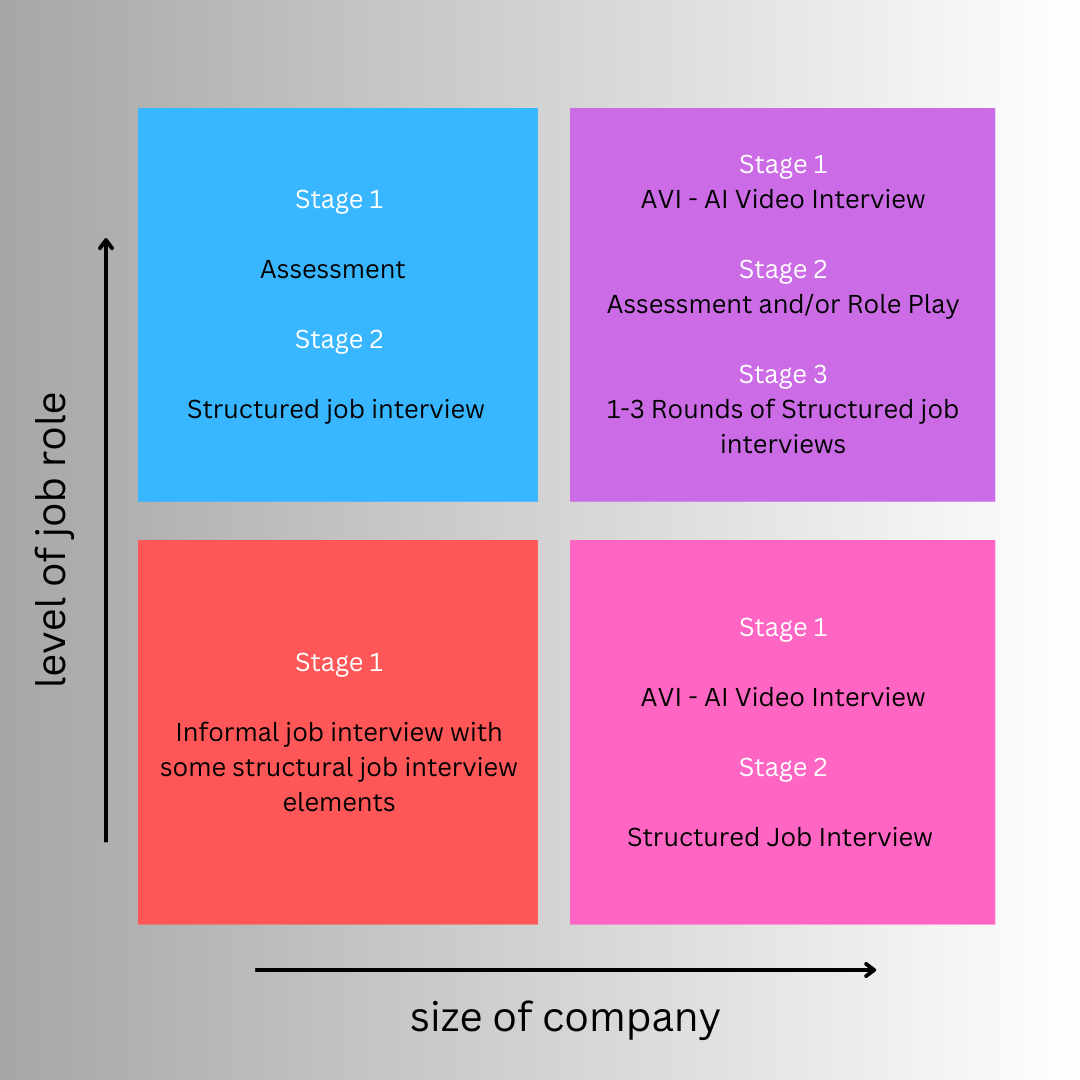
To help career professionals understand a potential forthcoming recruitment process, it is important to look at the level of job role and the size of the organisation.

Why the job level affects the type of job interview you will attend

The level of job role, from low-to-high skilled positions, has a direct result on the number of job interview stages and type of job interview questions an employer will ask.

Low-skilled (sometimes referred to as un-skilled) job roles include:

  • Waiter
  • Janitor
  • Transport driver
  • Warehouse operative
  • Care worker
  • Food production worker
  • Security guard
  • Farm worker

Source Indeed

As low-skilled positions often require physical or repetitive tasks to be performed, rather than the use of knowledge, creative problem-solving, or project management, employers will ask simple questions often based on the skills required for the vacancy:

  • Give me an example of working within a team?
  • Do you have experience of working in a factory?
  • How much time did you have off in your last role?

High-skilled roles require an employee that has had specialized training/higher education in order to operate, manage or participate in a project – this can be physical or mental.

Source: Investopedia

Larger salaries are normally associated with high-skilled positions, and therefore employers ask more specific and tricker questions to test the applicant’s ability to complete the day-to-day tasks related to the position being advertised. The interview questions can be based on actual duties or the required skills, IE, problem-solving.

  • What would you do if (situation) happened?
  • Give me an example of managing multiple projects with various deadlines. How do prioritise tasks, stay on budget, and collaborate with stakeholders?
  • How would you work out how many drainage grids are in London?

Research shows how a structured job interview, the asking of the same questions to each interviewee, with answers being marked via a scoring system, is the best way to predict job performance.

High-skilled job roles often require a level of knowledge/experience which results in the majority of employers adopting the structured job interview when recruiting high-skilled employees.

Senior positions, which often require either a long duration in the industry and/or sector-related qualification above a degree level, result in many recruiters wanting additional proof of knowledge/skills/experiences.

Additional interviews are common for high-skilled roles to check suitability. As are other interview stages: AVI screening interview, assessments, role plays, and working interviews.

Low-skilled interviews are either formal (unstructured) or informal (structured). In the main, employers adopt the informal/formal job interview based on the size of the organisation.

For low-skilled positions, a one-off 1-2-1 job interview is enough for a hiring manager to make a hiring decision. Some sectors have an additional group exercise task to review teamwork and communication – the size of the company influences the number of interview stages a low-skilled applicant has to go through.

The size of the organisation

Employer size, and popularity, have a massive effect on the time spent on recruitment from an employer’s perspective. As an example a small family company looking to recruit an IT analyst will receive, let’s say, 20 applications. A large and well-known brand, such as Amazon, Google, Microsoft, can receive in excess of 20,000 applicants.

Source: PathMatch

Such a high number of applicants per vacancy has resulted in large employers adopting AI to support HR hiring decisions.

To screen such a vast number of potential employees, hiring managers will ask additional shifting questions on the application form (relating to essential criteria) and will use AVI – autonomous video interviewing. AVIs in short are artificial intelligence interviewers, that ask around 3 structured interview questions and are programmed to cross-reference an applicant’s interview answers against the job criteria.

AVIs are a quick and easy way for a large employer to reduce the number of candidates without human intervention. Many employers recruiting for low-skilled employees, such as fast food servers, have embedded AVIs into their recruitment process.

Most employers still require a face-to-face formal or informal interview following the AVI, but anyone unsuccessful following an AI bot video interview will need to reapply for any further positions.

Larger employers, in the main, have well-embedded recruitment processes and procedures, which often include multiple interview stages for high-skilled roles, and less stages for low-skilled positions, with at least one interview stage being a structured job interview.

On the other hand, small companies have fewer interview stages even for senior roles, and, especially for a small family-run business, may adopt an informal interview. The informal interview is viewed as important for a small business as ‘fit’ is an important aspect of the hiring decision-making process. As is ‘loyalty’ – with loyalty meaning the duration an employee would stay with the small company.

Time and money influence the type of recruitment process a small or large company adopts. Smaller businesses, who recruit ad-hoc, are less likely to purchase an expensive AVI system, whereas the AVI is viewed as an investment and time-saving piece of tech for a large business.

The number of interview stages is also adjusted depending on the size of the company. Large brands will often have several rounds of interviews, especially for high-paying positions, to ensure they only recruit highly skilled and suitable professionals. Smaller companies are often satisfied with one interview stage for low-skilled roles and just two higher-skilled positions.

Evolve the mind book on Amazon

Can the job interview be predicted?

The three rules for passing a job interview are:

  1. Identify the job criteria – essentially predict the job interview questions
  2. Be a self-promoter – use various stories and examples that highlight the added value and the possession of the essential job criteria
  3. Communicate with confidence – which includes rapport building, easy to follow answer, persuasive language, and non-verbal communication

Knowing the job interview type, and therefore improving interview readiness, always helps to reduce job interview anxiety.

Even with an understanding of the common recruitment practices of large and small businesses and the level of job role, it is still hard to predict the interview stages for the job you are applying for. Or is it?

The goal of the recruitment process is to predict the job performance of the applicants. The barrier is that the anxiety created by the interview stages can create an environment where applicants don’t showcase their true self.

As mentioned previously, knowing the style of a job interview can reduce nervousness. With this in mind more and more employers are now stating the various stages of the interview and even explaining the type of interview questions, behaviour, or situational, that they will ask.

This openness from some employers hasn’t been rolled out to the masses. To date, many employers only state the interview duration. Also, there are no rules when it comes to job interviews, some employers will utilise one interviewer while another will use a panel of five. Interviews can last for 30 minutes or be a whole day assessment. Questions can be fixed or mixed, and some employers value skills or fit and vice versa.

The training an interviewer undergoes affects the interview environment, with many having no interview training at all. Some hiring managers will be nervous or confident, some will ask follow-up questions while others stick to the list of set questions, interviewers can be cold or warm, and some are experts in their industry. And, as discussed previously, interviews can be with humans, robots, and even some are now taking place in the metaverse.

Source: spotlight data

Based on the size of the company and the level of advertised position this interview grid can indicate the type of job interview a career professional will attend for various roles, helping job candidates prepare for a forthcoming interview.

Can you use ChatGPT to help pass a job interview?

ChatGPT is an open AI source that communicates with users in a conversational way while answering questions and helping people with various tasks from essay writing to creating code, and of course, helping job hunters to gain job offers.

The question career professionals are asking is: Can ChatGPT help me land a job? and If so, what do I need to do?

I asked ChatGPT to help me to answer commonly asked job interview questions and here is the advice I gained:

Sure, here are some sample answers to the job interview questions you provided:

  1. “Tell me about yourself?”

I am an AI-powered language model trained to assist and answer various queries. My purpose is to provide useful and accurate information to help people in their daily lives. I am constantly learning and updating my knowledge to ensure that I can provide the best possible assistance to my users.

  1. “Why do you want to work here?”

As an AI language model, I don’t have personal motivations or desires, but I can explain some reasons why someone might want to work for a particular company, such as:

  • I am impressed by the company’s mission and values, and I believe that the work the company does is important and meaningful.
  • The company has a great reputation in the industry, and I would like to be part of a team that is recognized for its excellence.
  • The company offers great opportunities for growth and development, and I am excited to learn new skills and advance my career.
  1. “What are your weaknesses?”

As an AI language model, I don’t have weaknesses or strengths in the traditional sense. However, some general advice for answering this question is, to be honest about areas where you may need improvement and demonstrate how you are working to overcome those weaknesses.

  1. “What are your strengths?”

As an AI language model, some of my strengths include being able to provide accurate and helpful information quickly, learning from past interactions to improve future responses, and being available 24/7 to assist users with their queries.

  1. “Do you have an example of working in a team?”

As an AI language model, I work with a team of developers and data scientists who are responsible for training and improving my capabilities. Together, we work to ensure that I am providing the best possible assistance to users and addressing any issues or challenges that arise.

  1. “Do you have any questions for us?”

As an AI language model, I don’t have questions in the traditional sense, but some suggestions for questions you might ask the interviewer include:

  • What qualities do you look for in successful employees in this role?
  • What are the biggest challenges facing the company right now, and how do you plan to address them?
  • Can you tell me more about the company culture and what it’s like to work here?

With the first set of answers, I wasn’t overly impressed being told over again that ‘As an AI model….’ Was it something I was doing wrong?

The answers given by ChatGPT do state good ideas – questions that can be asked at the interview end, but in the main, a quick search on Google would help a prospective candidate find better interview answers and more in-depth interview advice.

Business Insider also tested ChatGPT for its ability to write a cover letter. The AI-written cover letter was sent to real recruiters who, overall, liked the cover letter saying that they would invite the applicant to a follow-up screening call – the goal of a cover letter, but they also stated that ‘letters lacked personality and research about the companies’.

Indeed also looked into the generic interview answer problem, saying, ‘You can ask ChatGPT, “What are some tips for preparing for a job interview?” It will respond by telling you to research the company, review the job description and prepare to answer common questions.

They found that asking more specific questions would create more specific (potential) answers. As an example, instead of asking ChatGPT ‘What are common interview questions?’ ask ‘What interview questions would a (job role) be asked?’

Career tuners requested a mock interview with ChatGPT, asking for very specific information: ‘

I have an interview with (company name) for (job title) and the name of my interviewer is (name). Can you give me the following:
1. Information on the company, the industry, and its competitors
2. The culture of the company
3. How I need to speak to the company’s culture in my interview answers
4. Questions I can ask (interviewer’s name) at the end of the interview
5. Any mistakes I can potentially be making that would specifically affect my candidacy for a (job title) position with (company name)

The answers weren’t as impressive as hoped for, with some information being irrelevant and outdated.

Career Flow also found that asking specific questions is key: ‘While asking questions to ChatGPT, think of it as a very smart but very stupid machine. Despite being smart enough to know everything, it won’t give you an accurate answer unless you tell it exactly what you need.’

Is ChatGPT better than an AI-powered mock interview?

A secondary barrier to ChatGPT in helping to prepare for a job interview is not being able to read non-verbal communications; facial expressions, gestures, and even the candidate’s appearance, all, research has shown, has an impact on the interview outcome.

Google and Linkedin are helping job seekers by offering a free interactive AI-delivered mock interview. The post-interview feedback includes a review of the candidate’s interview answer, a filler-word counter, and additional interview tips – all advice that is missing when using ChatGPT to help land a job.

The final barrier for anyone relying on AI to support with their job interview is that it is difficult ChatGPT to predict:

  • The type of job interview each company will use; formal, or informal, a values interview, behavioral and situational interview questions, a panel or single person interview
  • The interviewer’s personality; a cold or warm interviewer – this is important as humans interact differently with different temperaments
  • Accurately predicting interview questions; two employers offering the same position, in the same industry may ask different questions
Evolve the mind book on Amazon

The benefits of ChatGPT for job interview preparation

  • Can help predict common interview questions
  • Answers given can be specific when a distinct demand is asked
  • Information is taken from various sources
  • Answers can be used as a template that can be reworded
  • It’s a great tool when an applicant is struggling to come up with any interview answer
  • And, it’s currently a free tool

The negative of using ChatGPT for preparing for your next job interview

  • Information given can be outdated or incorrect
  • Answers can seem robotic, or dry
  • Remembering a set of written interview answers is harder than discussing a memory or experience
  • It is unlikely to give answers for ‘value job interviews’ and questions about company culture
  • There isn’t a tool for checking non-verbal communication or communication style

Stop Making These Simple Interview Mistakes

Job hunters often fail job interviews due to the small mistakes they are making. These interview errors are often outside the job seekers’ conscious awareness – the applicant keeps failing job interviews without understanding how their years of industry experience and sector-related qualifications aren’t enough to land them a job offer.

Becoming aware of common job interview mistakes allows a career professional to reflect on their interview skills and make necessary changes.

Are you making these common interview errors?

Boxing yourself in.

Confidence, in a job interview, is key to success. And, confidence is portrayed by the communication of competencies.

To show confidence, the savvy interviewee will state specific facts ‘I know all about your company’ or ‘I am an expert in…’

Stating a specific fact can be a powerful affirmation statement. When confidently put, often the affirmation will be taken, without question, by the interviewer. It is a lack of skilled interviewers in the recruitment that allow confident statements to be taken as red. More and more, recruiters are being trained in the art of interviewing. One of the techniques taught to job interviewers is to ask for specific and measurable information, to challenge ambiguous statements, and to gather evidence to project job performance.

As an example, for the ‘I know all about your company..’ interview answer to the question ‘what made you apply for a role with our organisation?’ the trained interviewer may ask a specific follow question: ‘It’s great to hear that you have researched the organisation, what do you know X part of the company?’

This can make some interviewees lose credibility if they have to backtrack on their original assertation: ‘I know all about your company’

Job candidates, instead of making a sweeping statement can use specific information to embed into their interview answers: ‘After reading that your company was involved in X, I wanted to learn more about the organisation, and….’

A lack of flexible opinions

In the main, employees will have a level of flexibility in terms of job duties, ways of working, and their hierarchy of needs.

Employers like a flexible employee, especially as job roles evolve in line with ever-changing business needs. Being seen as inflexible or having a strong opinion that is the opposite of the interviewers can break rapport.

An example interview question is: ‘what type of manager do you best work under?’ can result in a strong opinion: ‘I strongly believe in a manager having X leadership style….’ If the stated leadership style differs from the culture of the company, the interview panel may feel that the applicant won’t fit in well with the current team.

The solution is to give a ‘options’ answer. An options answer gives multiple choices, embedded within the interview answer, which creates the illusion of an opinion where there wasn’t one. To answer the ‘best management style’ interview question, the job candidate could say: ‘different leadership styles suit different tasks and projects, as an example in X situation (sector-related situation) a good leadership style would be Y, but when (industry related example) a better management approach would be to…’

Other common interview questions that need a ‘options’ answer include:

  • Do you work best within a team or on your own initiative?
  • Are you a leader or a follower?
  • How would you deal with X situation?

2 mouth’s, 1 ear

Job hunters are famous for forgetting their GCSE biology. Humans have 2 ears and 1 mouth, not I ear and 2 mouths. In short, job hunters need to listen more than they speak.

During a job interview nerves and anxiety play a large part in the applicant’s job interview identity – how the employer perceives the candidate due to their verbal and non-verbal cues. Being nervous during the recruitment process creates a physical change in the brain resulting in a poor job interview performance.

  • Failure of the long-term memory
  • A lack of listening or understanding
  • Unable to process information
  • Increase in the use of filler words
  • Fidgets, sweating, and mumbling

Some interviewees, subconsciously wanting the interview to end, will start answering a question before the interviewer has finished asking it. Others misunderstand the meaning or reason for the interview questions, resulting in the delivery of an irrelevant example. And many will talk to quickly to be understood.

To answer an interview question well, the interviewee must:

  • Identify the job criteria the interview question references
  • Give a suitable example relevant to the specific interview question
  • Deliver a detailed answer, communicating the example confidently

An applicant unsure of the interview question, or those who simply don’t hear the question can:

  • Ask for the question to be repeated
  • Ask for specific information, as an example, for a ‘teamwork example’ you can ask ‘do you want an example of teamwork from my current role or from any time?’
  • Take a sip of water to give additional time (a few seconds) to digest the answer and help form the answer
  • It is also fine to say ‘that’s a good question, just give me a second to think of a suitable example’

The interview, from the interviewee’s perspective, should also be viewed as a conversation about the applicant’s skills and experiences, not a pressurised job interview. With this in mind, the interviewee should:

  • Ask more questions through the job interview
  • Clarify key points
  • Question the interview panel about their experience and opinions

Never lying

What? I thought you should never lie in a job interview!

Being too honest can be a barrier to employment. Imagine being asked ‘why are you leaving your current role?’ The truth might be that the company culture is toxic. But, stating this in a job interview can be seen as negative. The negative opinion is created because of interview stereotypes. Common interview stereotypes include:

  • Being late for an interview is a sign of being unprofessional (the reality is that a crash on a motorway could have caused a long delay)
  • Overweight applicants are lazy (see the research on obesity in recruitment)
  • Giving a negative opinion in a job interview means you are a negative person
Evolve the mind book on Amazon

Another question where the truth can result in a lack of job offers is with the job interview question: ‘tell me about the main duties in your current role?’

Interview answers, in a structured job interview, are scored on a point system. The points are awarded on the amount of criteria reference during the interview answer. If, for example, the main duties in the current role are significant for the new position, but secondary and third duties are more relevant, it is imperative to talk only about job duties that will score high on the interview scorecard.

‘Where do you see yourself in 5 years’ time?’ can be a tricky question if the answer is ‘in another company in a higher paid role, after gaining just the right amount of experience in this low salary position to apply for the new position!’

Instead, the savvy interviewee will tell a white lie, explaining how they will be loyal to the company.

To pass a job interview it is important to communicate how you meet the job criteria, while selling your unique selling points. Stand out from the crowd by delivering an outstanding interview performance without making these common interview mistakes.

CEIAG School Lesson Plan: Job Interviews

The CEIAG Job Interview lesson plan can be used to meet GATSBY benchmarks: 1 – a stable careers programme, and 2 – learning from careers and labour market information. Activities can be tailored to focus on a specific curriculum and job sector, supporting GATSBY benchmark 4 linking curriculum learning to careers, or as a more generic career guidance session.

This session is suitable for high school, further education, and higher education students.

CEIAG Lesson Plan Details – designed to be a flexible lesson plan which can be easily adapted to suit the needs of the class.

Duration: 60 minutes

Number of pupils: 10-30

Each interview activity last for 60 minutes, the whole lesson plan can be delivered as a CEIAG drop-down day event or each activity can be delivered on its own.

CEIAG Job Interview Lesson Plan – Activity 1

Become a confident speaker

The activity objective is to increase confident communication and can be used as an ice breaker as part of a full-day interview lesson plan or as a confidence-building activity.

Aims:

  • Increase confidence when speaking off the cuff
  • To learn how to give a detailed description
  • Become competent when answering ad-hoc questions

Each pupil in turn will stand in front of the class (or within small groups) and takes a question out of a box. The pupil then answers the question, taking between 1-2 minutes

Example questions:

  • If you could go back in time, what year would you return to?
  • If you could have a superpower, what superpower would you choose?
  • Tell me about your best holiday
  • Describe what you will be doing in 10 years’ time
  • What do you prefer carrots or sprouts and why?
  • Convince the class that a caravan holiday in the UK is better than a summer holiday abroad
  • If you were the prime minister for a day what would you do?
  • What do you prefer cats or dogs and why?

Once all the group have answered a generic question, ask the group what collectively they could improve to deliver a better speech. Answers often include:

  • Use less urms and arghs
  • Slow down
  • Speak straight away
  • Give more detail
  • More around
  • Gesture and eye contact

Using the advice, ask the pupils to repeat the speaking exercise using a new set of questions

CEIAG Job Interview Lesson Plan – Activity 2

What is an interview?

The key objective is for learners to recognise that they are likely to attend multiple interviews throughout their life

Aims

  • Recognise different environments where interviews will take place
  • Understand what a structured interview is
  • Learn the 3 rules for a successful job interview

Ask the class ‘when are you likely to be interviewed?’ Common answers will include:

  • Job interview
  • College interview
  • University interview
  • Apprenticeship interview
  • If you are famous

Explain that career data has found that most people will have 3 careers in their life, and its common for career professionals to change organisations once every 3-5 years. Most people attend 6 job interviews before being offered a job role.

In groups, ask the pupils discuss what happens in a job interview (for 5 mins). Ask different groups for their opinions. Explain that most organisation use a ‘structured job interview process’ this is where the interview panel ask the same questions to each interviewee. Their interview answers are then scored on a pre-set scale, often between 1-4, with 4 being the highest score. Points are awarded by the interviewer cross referencing the interview answers against a pre-written list of criteria for each 1-4 points.

Research has found that the top two interviewees only have a score difference of 1 or 2. That means if the other interviewee gains 3s across all the interview questions, and you get all 3s and one 4, you will be offered the job role.

State, the 3 rules for a successful job interview are:

  1. Identifying the job criteria
  2. Being a self-promoter
  3. Communicating with confidence

Ask the class, what each rule means:

  1. Identifying the job criteria

Understanding what skills, qualities, experiences, and qualifications the employer requires for the advertised job position. The interview questions will be based on the job criteria. Therefore, by knowing the job criteria a job applicant can predict the interview questions and prepare detailed job interview answers.

  1. Being a self-promoter

Being able to ‘sell’ yourself is key in a job interview. Never downplay your experiences and skills, and instead talk in detail about specific tasks you completed.

In groups ask the pupils to spend 10 minutes selling an item: a banana, a new style of pen, a pair of spectacles. Each group then ‘sells’ their item, focusing on the item’s benefits. After a group has ‘sold’ the item, ask the rest of the class if there are any other benefits that the group could have mentioned.

  1. Communicating with confidence

Confident speakers don’t use filler words, have awkward pauses, or talk too quickly. They also give more detailed answers, have better eye contact, and naturally gesture. Ask the group to mention famous (good) speakers and ask what they liked about their speaking style.

Summarise by asking what the three job interview rules are.

Finally, ask about other types of job interviews:

  • Group interview where applicants get involved in a group task. Employers here look at team work, leadership, and communication skills.
  • Test interview – often a Math and English test. Common in high skilled roles.
  • Role-playing, to look at how an interviewee would act in a particular situation.
  • Artificial intelligence robot interview – a new style of interviewing for large organisation’s. This is a video interview conducted by an AI bot. candidates are asked 3 interview questions which have to be answered within a set time frame. The AI bot then cross-references the answers against the job criteria before the successful applicants move to a human round of interviews. This is replacing the telephone screening interview process.

CEIAG Job Interview Lesson Plan – Activity 3

First impressions

The objective is to understand that we make generalisations when meeting someone new and how these opinions are often wrong

Aims:

  • Understand what stereotyping is
  • Become more aware of what makes good first impression in a job interview situation
  • How to promote yourself verbally and non-verbally

Show a pictures of around 5 different people. Ask, on first impressions who would you offer a job to and why. Give each group 5 minutes to discuss and then ask each group to feedback.

Explain how everyone stereotypes and makes opinions within milliseconds of meeting someone. Opinions are often created based on the culture of the country we grew up in, home life and personal experiences, values, and beliefs.

Ask the whole class what factors make a good or bad first impression? Common answers include:

  • What the person is wearing
  • Age
  • Makeup
  • Tattoos
  • Gender
  • Race
  • Eye contact
  • Posture
  • What they say/sound like

Ask the group who would be best for the following job role, and ask for reasons:

  • Engineer – a male or female
  • Computer game designer – an older or younger applicant
  • Customer service advisor – an overweight individual or an average-weight person

Explain that initial opinions are stereotypes. At this point we know nothing about the person. Repeat the questions again but give more context:

  • Engineer – a male who has recently left university or a female with 10-year engineering experience
  • Computer game designer – an older who invented the first gaming app or a younger applicant with 3 years experience in coding
  • Customer service advisor – an overweight individual with a level 3 customer service qualification and 6 years of customer service experience or an average-weight person with 3 years of telephone communication experience and a level 2 customer service qualification  

***this often results in pupils requesting more detail about the characters.

Ask the group to design the perfect interviewee. On a flipchart draw the elements the group state. This may include a suit, briefcase, hairstyle, etc

In small groups ask what the ‘perfect’ interviewee could initially say when first meeting the interview panel to help create a positive first impression. At the end of 5 minutes, ask each group to state their prepared sentences. Ask the larger class for feedback on the introduction. This can include verbal and nonverbal communication.

CEIAG Job Interview Lesson Plan – Activity 4

How to answer job interview questions

Become better skilled at answering job interview questions is the main objective for this activity

Aims:

  • Understand the SAP (situation, action, and positive outcome) model – an easier version of the STAR technique for school/college leavers
  • Become confident at answering interview questions
  • Better understand the job interview process

Explain that most job interviews last around 45 minutes with 2 or more interviewers asking, on average 8 job interview questions. The initial question is often ‘tell me about yourself?’ and the final question is ‘ do you have any questions for us?’

The middle 6 questions are often questions related to the job criteria – the duties and/or skills required for the main part of the job role.

Ask the group what the main job duties are for:

  • Engineer
  • Customer service advisor

Ask, with these duties in mind what questions will the interview ask? Write these on a board.

Example include:

  • Do you have experience of (duty)?
  • What do you do in X situation?
  • Give me an example of working in a team?

Explain the SAP (situation, actions, and positive outcome) technique. When giving an example of part of an interview answer use the SAP technique:

  • Situation – in one sentence describe the situation “I was asked to (solve a problem) help set up a fundraising activity”
  • Actions – describe specific actions you took “to do this, I first did X, then I did Y, and finally I Z”
  • Positive outcome – state what happened after the actions “this resulted in a great cake bake sale where we raised over £60 for the charity”

Split the class into pairs, ask each pair to pick 3 of the interview questions on the board, and ask them to prepare an interview answer. Give at least 15 minutes for this task.

As for a volunteer to be interviewed. Pick one of their chosen interview questions and ask the pupil to answer it. Focus here on content not delivery. Break down the answer. Did they:

  • Give a detailed answer?
  • Did they describe the situation?
  • State, in detail, the actions they taken
  • Was the positive outcome mentioned?
  • Was the language positive and self-promotion?

CEIAG Job Interview Lesson Plan – Activity 5

Become confident at answering multiple interview questions.

This activity can be completed as a ‘mock interview’ using local employers or teachers, or within the class with students interviewing each other.

First ask the pupils to take the teenager interview test to help them understand how they currently perform in a job interview: interview test

Choose interviewees and interviewers.

Each interviewer is given a common list of interview questions for a generic customer service role:

  • Do you have any experience in customer service, please share an example?
  • Give me an example of communicating something to another person?
  • Tell me about a time you were involved within a team?
  • Do you have an example of putting 100% into a task?
  • Have you ever had to plan for something, what did you do?

The interviewers ask one question to one interviewee, and then the interview moves to the next interviewer who ask the second question (this way the interviewers only ask the same questions to the different interviewees)

At the end of the interviewing, ask for feedback:

  • What was it like being interviewed by different interviewers – what was the difference in their approach?
  • Interviewers, give an example of a great answer.
  • Did you feel nervous as the interviewee or interviewer?
  • What did you learn from your role?
  • What could you do to improve your interview skills
  • Did everyone find it easy using the SAP technique?
Evolve the mind book on Amazon