Pacing, Leading and Embedded Commands for Job Interviews

Pacing, Leading and Embedded Commands for Job Interviews

As you read this induction, you are starting to feel excited about how to use pacing, leading and embedded commands in the job interview.  Did you spot the command in that first sentence? If not then this article has already highlighted how easy it is to embed commands into sentences that bypass the conscious mind, which means the unconscious mind picks up these commands without the conscious mind being aware of it.


Pacing and Leading

A quick demonstration for pacing and leading; match someone’s breathing pattern (pace) and once in rapport change your breathing pattern (lead) and watch their breathing change as yours does. You can also pace the interviewer’s body language by mirroring how they sit and their hand movements, once in rapport you can lead by changing your body poster and watch as the interviewer follows your lead by matching your new poster.  

Even more powerful match the interviewer’s language patterns (visual, kinaesthetic and auditory) once in rapport you can change your language to make the interview feel, visualise or hear what it is you want them to see, hear or feel.

Embedded Commands

Embedded Commands are highly powerful in interview situations as you can take the interviewer to an internal place and get them to think about wanting to hire you. Below are just a few examples to give you a better understanding of embedded commands. For embedded commands to be effective, they have to be hidden in a conversation.

Step one; set up – use an opening phrase such as:

“when you..”

“if you were to..”

“How does it feel when you…”

“you really shouldn’t…”

“A person can…”

Step two; Give a Command Verb (order) change your tone here or leave a small gap before and after the command–the unconscious mind will pick this up, don’t make it to obvious or the conscious mind will notice and think “what the hell are you doing?”

“become..”

 “experience…”

“think about..”

“remember…”

“have…”

“feel…”

Step three; State, Processes or experience

“Excited”

“a change of mind”

“that I am right”

“to learn more”

Examples:

“Before you HIRE ME, let me explain how I can add value to your organisation”

“IMAGINE I WAS WORKING FOR YOU, in this role I would be able to A, B and C..”

“yes I have a copy of my CV here, you will NOTICE THAT I WORKED FOR X COMPANY, while I was there I was part of the highly successful X project…”

If you enjoyed reading this article you will also enjoy reading:

Free CV Template download

Free CV Template Download

We have added even more CV templates for you to download for FREE.

The original CV templates can be found here: CV Template 

Remember the CV is the first impression the employer has of an applicant! Up to 3000 job seekers can apply for every advertised position, which means your CV template has to look professional but more importantly you need to state how you meet the employers essential criteria (which is usually record on the job specification).

FREE CV Review: Click Here

CV Tips

  • Keep your CV on 1 or 2 pages
  • Always use a covering letter
  • Tailor each CV for each advertised position
  • Only record relevant duties and successes
  • Use heading to break up the CV text
  • Delete negative or weak language

CV Template Download

Download CV Template in a word 2007 doc and PDF:

Once you have a interview winning CV you next need to plan how to influence the interview. Buy from Amazon today:

If you enjoyed reading this article you will also enjoy reading:


Interview Training Manchester

Interview Training Course Manchester

If you know that your highly employable, with tons of experience, qualifications and required skills – but for some unknown reason you cant secure job offers from job interviews it is highly likely that you need to improve your job interview skills.

Competition for jobs is at an all time high, with thousands of people applying for the same position, which means you need to go above and beyond the interviewees by highlighting your added value, showing your expertise and using influencing techniques.

Advanced Interview Training Course

On the advanced interview training course you will learn how to use Psychology, NLP and Hypnotic Persuasion techniques in the job interview.

Intrigued?

Think about the hundreds of ways you can use these specialist techniques to command job offers. We are the only organisation who has took techniques from psychology, NLP and hypnosis and applied it to the job interview situation

Do you Want to Learn more? CLICK THIS LINK

Interview Training Course

For those of you who have missed out due to the course popularity, or for those of you who need to learn how to use hypnosis, nlp, and persuasion during the job interview, you can buy the book that has took the course content to the next level

Interview Questions

Interview Questions

The recent recession and the way employers now use the Internet to advertise jobs has increased the amount of applications each employers receives for every advertised position. So how does this effect you? Well for one you need to stand out in the job interview, you need to predict the interview questions and you need to learn how to influence the job interview.

Today you find 31 Interview Questions to use to prepare your influencing interview answers:

  • Describe a situation you took
    full responsibility for a project
  • What are some of your
    expectations of your future employer?
  • Describe a work-related problems
    and how you solved them.
  • Do you posses any relevant work
    experience?
  • Have you ever dealt with an
    unsatisfied or angry customer?
  • How do you think you will
    compensate for your lack of experience?
  • Why did you choose your career?
  • How have you changed during your
    career?
  • How do you approach challenging
    problems?
  • How do you evaluate yourself?
  • How do you ensure you meet sale
    targets each week
  • If you disagree with your
    supervisor on an important issue of the job, what will you do?
  • What do you know about our
    company?
  • Do you understand the meaning of
    equal opportunities sand diversity?
  • Tell me about a suggestion you
    have made and the outcome from this
  • Tell me about a time that you
    contribute to a team activity
  • What is your main career aim?
  • Over 60 Interview Questions and
    Answers
  • How can social media websites
    promote our business?
  • What was the most useful
    criticism you received? Who was it from?
  • How would you describe the pace
    at which you work?
  • What has disappointed you in a
    job?
  • What do you feel about diversity
    in the workplace? Do you think it is important?
  • Do you consider yourself
    overqualified for this position?
  • Do you know anyone who works for
    us?
  • What one word describes you?
  • Do you possess a criminal record?
  • How do you prioritise your work
    to meet deadlines?
  • What is your typing speed – words
    per minute?
  • How do you handle rejection?
  • How long have you been looking
    for a job?


With a list of interview questions, your next stage is to learn how to influence the job interview using psychology, nlp and hypnotic persuasion

If you enjoyed reading this article you will also enjoy reading:

How to Change the Interviewers Opinion of You.

How to Change the Interviewers Opinion of You.


A client came to see because when he attended his last interview, he got the impression that from the start of the interview the employer had a negative opinion about him. In these situations, you have the disadvantage of the employer filtering all your interview answers through a ‘negative filter’ which generally creates a stronger negative view of you, which means you first need to change the employer opinion of you by breaking down their belief regarding you.


These filters happen in everyday life, remember back to a past relationship, when you meet someone who you initially like and this person has a habit that you might say is “cute” as you are filtering this information through a positive filter. After a while, you realise that this person is not for you, as they continue you do their habit you filter this through a negative filter and this once cute habit now really annoys you.

 

You can learn to breakdown a person belief system through ‘conversational change’ or what we call in NLP as ‘slight of mouth patterns.’ Below you find 14 slight of mouth patterns and examples of how to word them in a job interview setting. These suggestions are design with the examples of negative beliefs we have recorded below in mind, which means it more important to understand the patterns so you can apply them to your own interview situation.

Change the employer’s opinion

People’s beliefs are created through a variety of things including their past experience, their state and their generalisations. Beliefs can come in the form of:

  1. 1.    Complex equivalence (A  “means” B)

“Everyone who works at company X is lazy” (complex equivalence)

  1. 2.    Cause-effect (A “causes ” B).

“If you’re under 40 you don’t have the required knowledge or experience need for this position” (cause and effect)

Sleight of Mouth Pattern Examples

Redefine; change the representation of the belief  

  • What other meaning could the equation have?

Example SOMP Question or Statement: so what you mean is, that because I want to leave company X I’m a hard worker?

Consequence; consequences that can change beliefs

  • What will happen to them if they continue to think this way?

Example SOMP Question or Statement: if you believe that, you might miss out on some top rate employees who may be an exception to the rule

Intention; what is the positive intention?

  • Why are they saying this?
  • What is the secondary gain?
  • What are they trying to get?

Example SOMP Question or Statement: I agree, sometimes older employees are more experienced, but I have been specialising in this area all my life and I am the only one who knows how to implement X

Chunk Down; specific elements

  • What specifically?
  • What are examples of this?
  • What are parts of this?

Example SOMP Question or Statement:  what do you need to hear that will convince you I have the knowledge you require?

Chunk Up; generalisations

  • For what purpose?
  • What’s important about this?
  • Exaggerate.

Example SOMP Question or Statement: its not that the workers are lazy there just managed wrong

Counter Example; exceptions that challenge generalization

  • Invert the belief.
  • Make into a universal statement or question
  • A causes B, not B causes not A.

Example SOMP Question or Statement: we have all met people old and young who surprise us

Another Outcome; propose a different outcome

  • What is another outcome you could shift to?

Example SOMP Question or Statement: if you invested in me as a person with my strong work ethics, you would see a big monetary return

Metaphor/Analogy; Use an analogy or metaphor that challenges the generalization defined by the belief

  • What story will relate to their belief?
  • Tell a metaphor or story about the solution.

Example SOMP Question or Statement: my current manager said he took a chance employing me as I was new to the industry, but he said he seen something in me and know he rates me as his number one performing employee.

Apply to Self; use key aspects of the belief to change the belief

  • Don’t think about it; just use the word back on itself.

Example SOMP Question or Statement: “You don’t have the required knowledge or experience need for this position, unless you’re passionate about this sector, no matter if your 40, 30 or 50”

Hierarchy of Criteria (Values) Re-assess the belief based on a more important criterion.

  • What is a higher criteria (values)?
  • Apply current criterion (value) to current sentence.

Example SOMP Question or Statement: isn’t it more important to think about what value I can add to the organisation then how old I am

Change Frame Size; Re-evaluate the implication of the belief in the context of a longer (or shorter) time frame, a larger or shorter number of people (or from an individual point of view) or a bigger or smaller perspective.

  • Something (larger or smaller) they haven’t noticed.
  • Different frame, same behaviour.
  • Chunk up to Universal Quantifier.

Example SOMP Question or Statement: employing a younger member of staff will mean that the older employees will want to work harder to seem just as enthusiastic

Meta Frame; change the basis of the belief

  • How is it possible they could believe that?

Example SOMP Question or Statement: you can’t employee some on their age alone, but you can employ someone or their knowledge and skill base, especially when I have evidence to back this up

Model of the World; look at the belief from a different perspective

  • Switch Referential Index.
  • Is this true in everyone’s Model of the World?

Example SOMP Question or Statement: if you were interviewing the you at my age, would you employ him?

Reality Strategy; Re-assess the belief based on the fact that beliefs are based on specific perceptions

  • How do they represent that belief?
  • How do they/you know if it’s not true?
  • Apply current criterion (value) to current sentence.

Example SOMP Question or Statement: how do you know that all people from company X are lazy and not just the few of them you have met?

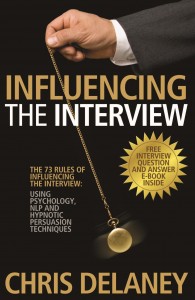
In the new book ‘Influencing the Interview’ you will learn several new ways of getting out of tricky interview situations and you will also learn how to use hypnotic interview language to secure more job offers.
 

If you enjoyed this article you will also enjoy reading:

 

How to Prepare for an Interview

How to Prepare for an Interview

This Months Guest Post comes from Chris from Zazzle Media

Getting a job is incredibly difficult for people of all ages and abilities at the moment, with more and more people finding themselves out of work as firms look to save money. However, should a job come up that you feel is perfect for you, it is important that you make it yours and stand out from all of the other candidates.

While you can present a fantastic CV filled with essential qualifications which meet or go beyond the necessary criteria, you could be just one of a number of potential candidates for the job so it is vital that you perform well in your interview – if you’re lucky enough to get one of course!

To help you to standout in your interview, here are five of the most important tips that will enable you to impress your potential employer and, hopefully, earn you a job!

  • First impressions count. It sounds quite obvious, but first impressions really are the most important in an interview. Employers can take an immediate liking or dislike to someone who turns up looking unprofessional, i.e. dressed informally, unshaven, covered in make-up or wearing too much jewellery. For men, dressing in a suit or at least a shirt and tie is a must, while women should favour a smart dress or blouse and skirt, which will give a professional look, but don’t go showing too much leg or wearing insanely high heels
  • Do your research. If you walk into an interview unprepared, you won’t get the job. It’s a harsh fact, but it is a fact. Do your research into the company, such as the name of the founder, the year they were formed, the name of the boss, a number of their other locations, and, most importantly, what they actually do. Don’t turn up to an ICT interview thinking they just work on computers all day, they do far more than that so find out what it really is and why you can do it better than the other candidates.
  • Answer the questions. A common interview mistake is to start “waffling” and moving away from the topic by saying what you think the interviewer wants to hear. In some cases, they just want you to answer the question they asked. If it’s a short, to the point answer, so be it. Don’t feel the need to pad it out with irrelevant comment
  • Be able to demonstrate why they should employ you. If a job description asks for a good communicator, be confident and give good quality answers, don’t clam up and go quiet. Similarly, if it asks for experience with certain computer software, explain how you’ve used it, why and your thoughts on it, maybe even explaining how it can be used more effectively.
  • Have a positive body language. While it may be your most comfortable way of sitting, a slouched position in the chair will give the impression of someone who isn’t interested. If you sit up straight and look the interviewer in the eye as much as possible, smile and laugh, then it will make them think you could be the one for the position.

Having landed yourself an interview, the most important thing to do is to come out of it feeling as though you’ve done your best. If you’ve answered the questions to the best of your ability and shown them what makes you the perfect candidate, you can do no more. Good luck!

If you enjoyed reading this article you will also enjoy reading:

Can You Use NLP in Job Interviews?

Can You Use NLP in Job Interviews?


I am often asked “can you use NLP in job interviews?” and the answer is YES! So many of my clients come to me because they know they have the skills, experience and qualifications to be an effective, proactive and professional employee, but like many others they can’t pass job interviews.

Some people are limited by their interview nervous and lack of confidence, others don’t know how to structure their interview answers and lack the knowledge of sales psychology to use the interview answer as an opportunity to sell themselves to the interviewer. I have met clients who know the basics of passing interviews but lack the ability to use the interview to influence the employer.

We would all agree that the interview is essentially a sales pitch and NLP can give you the upper hand in job interviews, but we have gone one step further. As well as using NLP, you can now learn how to use NLP, Psychology and Hypnotic Persuasion in job interviews.

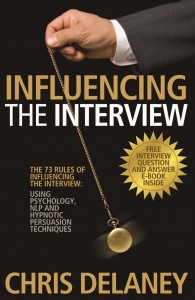
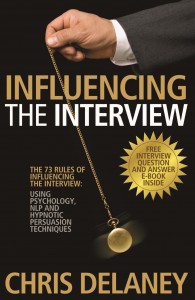
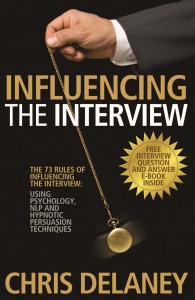
The 73 Rules of Interview Influence – using Psychology, NLP and Hypnotic Persuasion, will give you the tools to stand out in job interviews, giving you the techniques to access Instant Confidence, while reducing your Interview Nerves. You will learn how to become an Industry Expert, making the employer see you as a valuable commodity.

You will learn the dark side of Sales Psychology, and how to Manipulate the Employer with NLP and Hypnotic Language Patterns. We have took the best from Psychology, NLP and Hypnotherapy and made it relevant to the job interview, giving you the power to kill the competition and to come out on top in these competitive times.

Can You Use NLP in Job Interviews – in the Influencing the Interview Book you will learn a vast amount of NLP techniques including

  • Perceptual Positions
  • Sub-modalities
  • Logical Levels
  • Fast Phobia Technique
  • Milton Model Language Patterns

Remember, this is just a taste of the skills you will learn, as well as NLP you will how to use Psychology and Hypnotic Language Patterns

  • Embedded Commands
  • Yes Sets
  • Re-frames
  • Trance Work
  • Language Patterns

So what to do next? Click the image below and ORDER YOUR BOOK NOW and see the difference this book will make in your next job interview. You are probably already imagining all the hundreds of ways the 73 rules of influencing the interview can be used in your next job interview. I will also let you in on a secret, you can use the same techniques in all the areas of your life from Attracting new Partners to gaining Promotions. From Increasing sales to getting people to Instantly fall under your power.

If you enjoyed reading this article you will also enjoy reading:

Telephone Applications That Get Results

Telephone Applications That Get Results


Many job searches like you will be pro-active in their job search, telephoning companies speculatively to gain employment. The speculative telephone application can be a great way for you to open new opportunities, as many other job searchers fail to complete or even attempt this easy job search tactic.


Don’t Miss Your Opportunity to Shine


On average you will have around 5 minutes to sell yourself to the employer, and most job hunters mess this up by opening with a sentence asking them for a job! I know this sounds like the right technique to use, but it doesn’t work in most cases.


This is because the employer isn’t interested in you. And why should they be? They have never met and in most cases never heard of you until this first phone call. To be successful applying speculatively, you need to employ sale tactics to win job interviews, as explained in the new book “>Influencing the Interview.


The employer will only recruit you, if you can add value to their organisation which is why you have to open up your conversation stating what you can offer the employer – your unique selling point.

 Your Unique Selling Point

Hopefully you will have many selling points, what you need to do is write them all down. After this research the organisation you would like to work for and get an insight to their values, beliefs and mission. By understanding what the company value you can match this criteria to your selling points, with this knowledge you can open up your conversation stating what is important to you “helping others to achieve their goals” “making advancements in the medical field” “sharing knowledge to empower others” which through your research will also be important to the company.


This way you are speaking the employer’s language, once the employer is intrigued you continue to influence them by adding that you are telephoning to apply for the position, and how you would help the company achieve their goals/mission. “I’m telephoning today as I am interested in applying for a position as X in your company; by recruiting me I would XXXX…”


This section is together so the employer hasn’t the time to say “unfortunately we have no positions available” without them hearing your unique selling points. And if you become a valuable asset (you wow the organisation with your unique selling point) to the organisation they will have no choice but to interview you, as they will feel intrigued to find out more.

 In 3 Steps

  • Open with your unique selling point that matches the company values or mission
  • Follow this with, why you are telephoning the employer – to apply for a job
  • And finally without leaving a long gap – sell yourself in a quick paragraph summarising why the employer NEEDs you

You can learn how to influence interviewers on a higher level today by reading this newly released book – influencing the interview using psychology, nlp and hypnotic persuasion techniques

 If you enjoyed reading this article you will also enjoy reading:

Interviewers use lie detectors test in job interviews

Interviewers use lie detectors test in job interviews


With advancements in technology, we are now seeing a shift in the job interview with more interviewers investing in equipment to   find the interview fakes and liars. On average large organisations spend around 40% of their profits on recruitment, often due to rehiring and re-interviewing due to an initial poor choice of candidates.

Can you cheat the Interview?

A lie detector machine can indicate when an interviewee has lied due to sensors picking up slight changes in a person’s breathing rate, pulse, blood pressure and perspiration. The days of lying to the interviewer, to cheat your way into a new position are fading. Employers want to recruit the best and a lie detector can assist employers to make the correct choice.

If you can’t lie to the interviewer, hypnotise them.

 Why cheat and lie, when you can hypnotise the interviewer to offer you a job? Interviewers think they have the upper hand, and this is what a good interviewee wants the employer to believe – this way we can secretly influence, manipulate and persuade the employer to offer you a job without the interviewer knowing what you are doing.

Influencing the interview.

Conversational hypnosis has been created to hypnotise the interviewer through conversation using embedded commands, re-frames, negative commands, yes sets, sales psychology and hypnotic language. All of these techniques, many of which employers would be furious about if they found out how interviewers were using them during the job interview, come from the dark side of persuasion. The new book Influencing the interview has taken the best from psychology, nlp and hypnotic persuasion and made it relevant to the job interview – giving you the interviewee the power. Competition for jobs is at an all time high, candidates have to stand out during the job interview, you need to go above and beyond the old style interview skills used in the 1990’s to win job offer during the hard and competitive times in a recession.

If you enjoyed reading this article you will also enjoy reading: