How to Read Micro Facial Expressions

Today you will learn how to read micro expressions, this means you will have the power to really understand what is going on in someones mind, as micro expressions are hard to hide which means you will really know what the other person is thinking, just by looking at their face.

  • This Article will teach you how to read micro expressions and later you can participate in an interactive micro expression test

Research into micro expressions is being extended, as psychologist like Paul Ekman (the leading expert in micro expressions and emotions) has proven that certain micro expressions such as Anger, Contempt and Happiness are universal. These studies will help people in professions such as Airport Security, Police, MI5, Teachers, Coaches and a whole range of other industries. Why? Because if you can read micro expressions you can understand how the person is really feeling, which is Different to how they say they are feeling.

I agree people can fake smiles and other emotions, but micro expressions happen so quick and are so  instant that if you the micro reader blink you can miss them. This is why reading micro expressions is a key to understanding how someone really feels, as the subject often doesn’t know that they have made them – micro movements are made through unconscious movements of the muscles

How to Read Micro Expressions
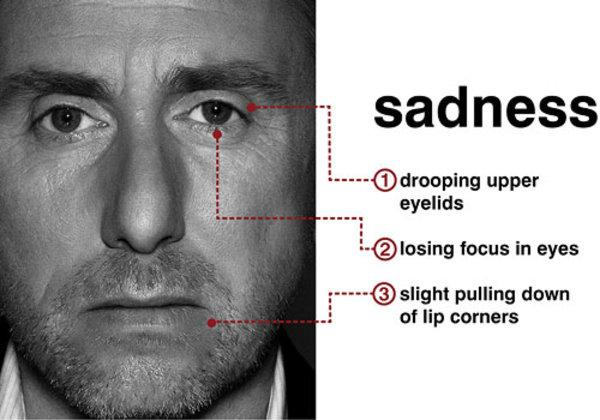
 

1. Sadness – narrowed eyes, eyebrows together, down-pointed mouth, and a pulling up of the chin

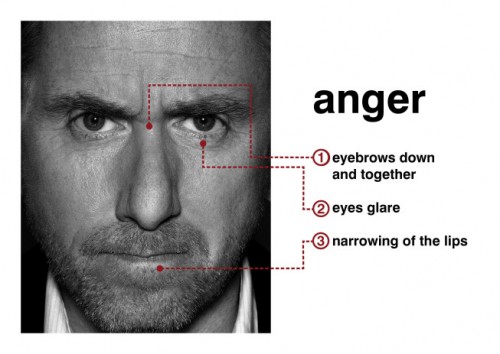
2. Anger – lowered eyebrows, tense lips and eye lids and wrinkled forehead

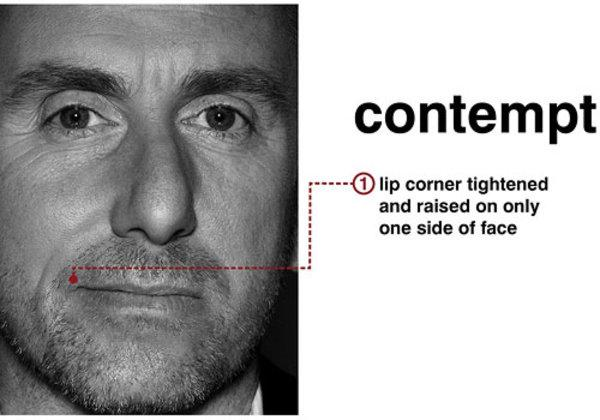
3.  Contempt – single raised corner of the mouth, slight tightening of the eyelids (sneer)

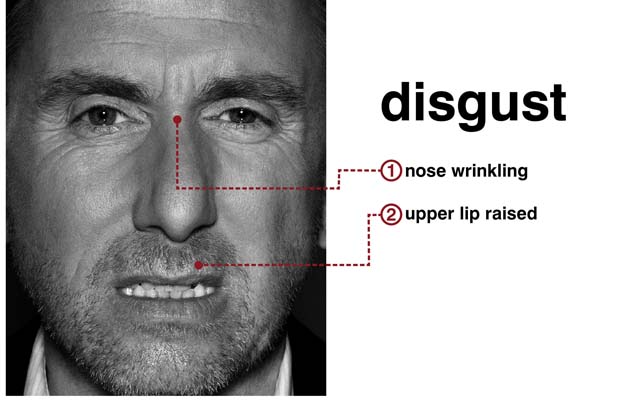
4. Disgust – raising of upper lip, narrowed eyes, wrinkled nose and narrowed eye brows

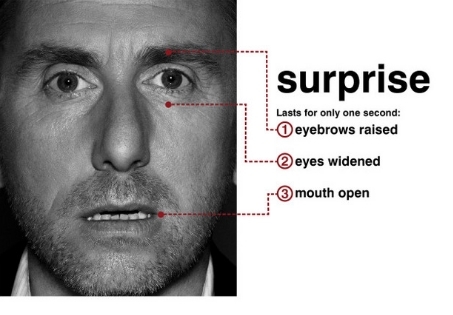
5. Surprise – dropped jaw, relaxed lips and mouth, widened eyes and slightly raised eyelids and eyebrows

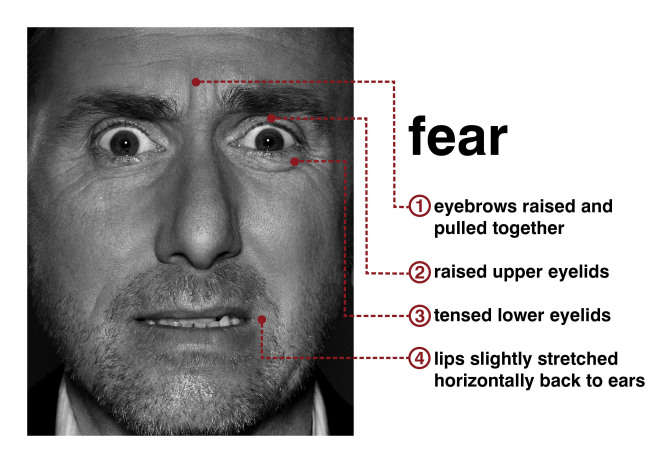
6.  Fear – eyes and mouth open rather widely, eyebrows raised and nostrils flared

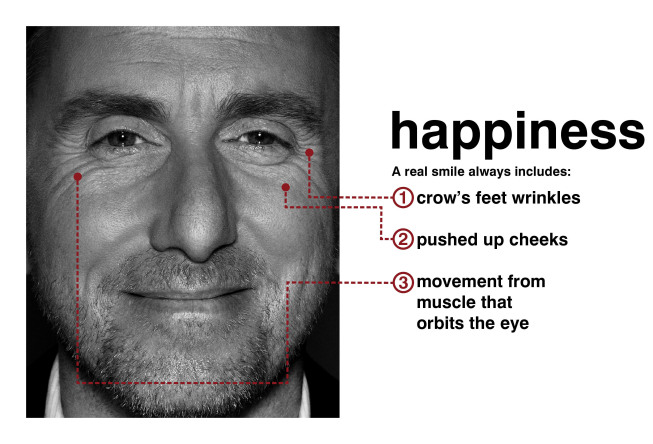
7. Happiness – raising corner of lips and cheeks, narrowing eyes to produce “crow’s feet” on the outside of each eye


Tim Roth (above) Stars as Dr Cal Lightman in the hit series Lie to Me, a great show where Dr Lightman and his team tackle a weekly mystery by reading micro expressions, body language and verbal cues.


So, back to reading micro expressions. To become an expert you need to practice, re-read the emotion explanations and then watch this facial expression video on YouTube Facial Expression Tutorial by Khappucino 

Go over this video a couple of times, to increase your facial reading abilities and then take a Micro Facial Reading Expression Test

How did you do? Remember the more you practice the better you will become and as with all mind/body/language reading you need to look for clusters and not to make judgments on single instances

If you want to learn more about Emotions and Facial Expression, learn from the master himself Paul Ekman, read his amazing book Emotions Revealed. Buy the Book Now by clicking the image below:

If You Enjoyed this Article You Will Also Enjoy Reading:

Successful Women

Successful Women – why are some people successful, but others are not? Can You Be More Successful?


I always feel inspired by successful people in all disciplines from sports to movie stars, from great scientist to successful business people, especially those people who came from nothing and motivated themselves to be their best.


We have heard of many successful men who came from nothing, which is why this article highlights 3 highly successful and powerful women, who made it through their own determination.


My research highlighted two key similarities that all successful people posses;


  1. All successful people have a vision or goal, but unlike others, successful people truly believe they will achieve their goal and when they visualize this goal they can see their outcome from the eyes of their future successful self. What does this mean? By being associated to their outcome (seeing their outcome from their future successful self) they feel as they have already achieved their goal and use this feeling to continue to feel motivated compared to many others who look at their goals as if they are watching themselves on TV (being disassociated from the feeling of success)
  2. When successful people make mistakes, they don’t give up as they see any mistakes as an opportunity to learn and improve which means the more mistakes they make the better they will become. It is this self belief that motivates successful people in times of potential negativity where other people would just give up.


Oprah Winfrey a famous talk show host, actress, producer and businesswomen was born into poverty in mississippi to a signal mother.

Lacking self confidence through an abusive childhood, the young Oprah turned to drugs and ran away from home to help overcome her childhood drama. Later her mother made Oprah move in with her strict father who made Oprah return to school.

While in school Oprah won a speaking contest and two beauty pageants which inspired Oprah to become a talk show host.


After working in the media for several years Oprah audition for a talk show job, the nervous Oprah auditioned believing that an overweight black women applying for a talk show host job in America would be laughed out of the audition. To her surprised the producers seen “something” in
Oprah and she was offered the job.


With her determination to be successful, she took the talk show to new heights and after a couple of successful series the show was renamed the Oprah Winfrey show and the rest is history.


J.K. Rowling found her passion of story telling at an early age and would spend hours telling stories to her baby sister. J.K Rowling started writing at the age of 6 and by the time she was in high school she wanted to take writing seriously. It was during this
time that her mother became ill with multiple sclerosis.


In 1990 while flat hunting in Manchester JK had the idea for “Harry Potter” later saying the idea “just fell into her head.” While writing Philosophers Stone JK’s mother died at the age of 45.


For 3 years JK moved and lived in Portugal where she worked as a Teacher while continuing to write the first Harry Potter book. While living in Portugal JK was married and became pregnant with her daughter Jesscia. In the same year JK then return to the UK with a completed manuscript.


While bring up her daughter signal handed (as JK and her husband had split up) JK continued to edit and type up the book working between baby feeding times and working late into the night, this shown JK’s commitment and determination as many other people would of gave up due to the amount of work bringing up a daughter and writing a book entails.


JK sent her completed manuscript to several agents and one finally asked to meet her. It took another 12 months and lots of “no’s” from publishers before “Bloomsbury” made an offer to publisher her book and we all know what happen next.


Norma Jean Baker “Marilyn Monroe” the most famous female actress in the world was in 1944, told by a modelling agency “You’d better learn secretarial work or else get married.”


Born in 1926, Normas father abandoned the family and Norma grew up not knowing who her father was. Norma and her mum who had a mental illness lived mainly in poverty and Norma spent much of her life living in foster homes due to her mum being in and out of mental hospitals.


At the age of 16, Norma married a 21-year-old aircraft plant worker James Dougherty, the marriage would only last for 4 years.


In 1942 she had started to model swimsuits and had bleached her hair blond. It was later on after being told to “get married or become a secretary”, which she ignored, that these modelling pictures caught the eye of RKO Pictures who offered Norma a screen test, later Norma
would sign contract with 20th Century Fox.


Norma changed her name to Marilyn and went on to become the world’s biggest female actress of all time.

Do You Want to Be More Successsful? Learn the Secrets of Success from Dr Richard Bandler the co-creator of NLP. Click this Banner Below for More information:

If You Enjoyed Reading this Article You Will Also Enjoy Reading:

Secrets of Success

The Secrets of Success Limited Edition DVD Box Set BRAND NEW By Dr Richard Bandler

If you knew the Secrets of Success, how would your life change for the better? What would you achieve?  Dr Richard Bandler the co-creator of NLP is back with a new LIMITED EDITION DVD box set – The Secrets of Success.

Richard Bandler models four immensely successful people whom you will learn from, be inspired by – and whose skills you will be able to use in your own life.

The four stars of the show he interviews are:

  • Celebrity chef and restaurant chain owner, Aldo Zilli
  • Olympic Gold meda-winning runner Iwan Thomas
  • Multi-millionaire businessman Andrew Morris
  • Famous British actor, Christopher Ellison.

In The Secrets of Success you will see Richard modelling each of these immensely successful people, extracting from them powerful tips that will you will find incredibly useful in your life.


Among the many secrets of success you will draw from this box set, you will discover:

  • how the most successful people are so often unable to acknowledge their own success – so they have more of a driving edge
  • how hugely creative people generate images in their mind that draw them inexorable towards them
  • how rehearsal over and over again in the mind’s eye can lead to excellence in performance
  • how being an inspiration to others made a millionaire rethink his life
  • what the responsibilities are of being the man in the public eye
  • how the right motivation is the key to making you learn
  • what are the big secrets that the amazingly successful go for what they want – and how you can use those secrets in your life, too.


PLEASE NOTE: The Limited Edition Secrets of Success will comprise a tightly restricted run of ONLY 500 sets. Because of
that,we are expecting this set to sell out.

And as FREE EXTRAS in the LIMITED EDITION set ONLY, you will additionally receive:

  • Face To Face with Richard Bandler – a fascinating DVD in which Richard discusses and reveals the thinking behind his life’s work: NLP. Worth £27
  • An audio CD of each Secrets of Success programme, alongside each DVD, so that you can listen to Richard’s interviews and conclusions while you’re driving or relaxing. Worth £49.95

What to do Next? Click this Image:

If you enjoyed reading this article you will also enjoy reading:


How to get out of any argument or disagreement with your boss

How to get out of any argument or disagreement with your boss, manager and colleagues


One of the most common asked questions I receive is how to get out of an argument or disagreement with a manger or boss. I agree this can be a tricky situation as you can automatically feel accused and respond with a defensive answer which often leads to a disagreement with your manger.

What you need to learn is how to turn the accusation back on itself in one simple line.

How to get Out of General Disagreements


This simple NLP technique will not only get you out of a disagreement but will make you look good in the process by making your manager respond to your questions. First let’s look at what causes disagreements:


Generally your manager or boss will accuse you of something without knowing all the facts, which leads to a general accusation “everyone feels you are not pulling your weight” when feeling accused, we will often defend ourselves which makes us look guilty “but, I work really hard” after a few exchanges, with you the employee feeling more and more defensive this accusation has turned into a full blown argument


When accused by your manger and they use a “general” statement, don’t get defensive, get specific and get the details, this way the manger has to give you evidence “who exactly said I’m not pulling my weight?” “well, erm..Tom and Dave” “Ok so, two people said I’m not pulling my weight..” this is a big difference then the original – everyone “and which task did I not pull my weight on?” “erm, I’m not sure really…” now the manger is backed in a corner, while you have remain professional and calm.


How to get out of Accusation


In some cases your manger or boss may say a damaging statement to put you down, in many cases this may be more specific then the “general” example above which means you need a different approach, a different frame.


By re-framing (as we say in NLP) you can put a different and more positive approach on any accusation. My friend recently said to me she felt down after putting on some extra weight after eating too much cake at her child’s birthday party, which I replied with “so, what your saying is the extra cake you ate is a sign that you had fun and were enjoying yourself at your child’s party?”


This technique can be easily used with your boss, when given a damaging statement in an appraisal, meeting, promotional job interview or just in the office or on the shop floor.  It doesn’t matter what you are accused off, it’s how you respond and reframe the question that is important


Let’s look at these recent real life examples from my career coaching clients and the responses they used


  • Promotional Interview “you’re not very creative” Interviewee Response “so, what you’re saying if I show you a creative suggestion you will be interested?”
  • Negative Manager “why do you never understand what I mean?” Employee “so, what you mean is, if I summaries what you have asked me to do after each instruction, you will know that I understand you”
  • Negative colleague “why are you always late?” you “are you asking what has happened in my private life, to make me late for the past few days?”

By turning the question around and getting specific means your manager has to agree or answer your question; with the first question (creative) the interviewer can only agree with you or look stupid. The second question (negative manager) here you have changed the question, its no longer about you not understanding it is about you confirming your understanding and the third example, the negative colleague (lateness) the rude colleague will first feel embarrassed but the conversation has moved from you being late to the reason why, which you can reply with “I cant talk about it now, but I might discuss it with you later” this final line, stops the colleague asking any more probing questions.

If you enjoyed reading this article you will also enjoy reading:

Goal Setting – How to really achieve all your goals

Why do some of us achieve our goals while many others want the same outcome but do nothing about it? If you knew how to achieve all of your goals, how would your life change for the better?

Today and for a short period of time you can download Employment Kings Goal Setting technique which will share with you the techniques to achieve any of your goals – Career, Life, Business, Relationships and anything you really want to achieve.


What to do next? Click Here: DOWNLOAD Your Goal Setting Technique NOW

Download the goal setting techniques, achieve your goals and let me know your success by e-mailing info@employmentking.co.ukor by adding your own blog comment

If you enjoyed reading this article you will also enjoy reading

I Want a New Career But I Don’t Know What To Do!

I Want a New Career But I Don’t Know What To Do!


Are you like so many other people, who are in the wrong job? Or are you ready for a career change? Do you want a new career but you don’t know what you can do? Then you will want to read this article which will in 9 easy steps help you great a carer idea you will love, then all you need to do is learn the secrets of employment and secure more job offers then ever before.

First read each of the nine steps before returning to step one to start your journey to finding your new career.


  1. Job Titles are for losers from working with hundreds of career hopefuls, I have realised the biggest barrier to finding you a perfect career is Job Titles. Job hunters will often say “I Don’t want to be a doctor (or any other job title)” “I have though about working in Media (or any career sector) but it’s not really me” if you knew what job title you wanted you would be job searching by now, if your unsure on your career ideas start by thinking about your likes and dislikes and for now ignore all the job titles as they limit so many people – you have to remember there are thousands of job roles out their, it’s like looking for a career needle and a job sector haystack.


  1. List Your Likes and Values start by looking at everything you value and like in a perfect career, this could be hours, respect, promotional opportunity, personal development, fulfilment or money. Make your list big at least 20-30 elements. Once you have record your “wants” put them in order of importance by asking would I prefer a job role with Criteria A or Criteria B? Work through your list in this way.


  1. List Your Don’t Want’s now you have a list of your wants, record a list of your dislikes, what don’t you want in a career? You may record criteria’s as such as; more then an hours travel, working in a noisy environment, no personal devolvement, a manager who doesn’t offer support, etc. go through your list and ask yourself, if I was offered a job with 3-5 of my wants and this one “don’t want” criteria would I accept the job offer? Ask this for all your “don’t want” criteria as this will let you know how important your Don’t Want criteria list is to you.


  1. Where is your best working environment? Next think about where you work best, do you work best in groups or alone? Do need a quite place of work or do prefer to work in a noisy environment? What environment most motivates you, indoors or outdoors? In city or in the country? Do want a job where you visit different places of work or working destinations or do you want to work at the same venue day in and day out? Upmarket venues or downtown places? Where is your ideal place of work?


  1. If you could do anything what would you do? Imagine you lived in a magical world, where you can choice any career you wanted and it didn’t matter about your qualifications, experiences and every salary was the same. All you needed to do is pick any career and you could start tomorrow – without thinking about your ideal career what job has just popped into your head?


  1. Can the future you give you advice? Imagine for what ever reason, the next twelve month work out for the best, every choice you make is the best choice, every goal you set you achieve, you pass every job interview  and you’re the happiest you have ever been. Imagine you can see a picture of you in twelve months time, what are you doing? Do you look happy? Do you look healthy, where are you working? Imagine you are this future you looking back down your time line to the version of you reading this article, what advice would this future you give the you now?


  1. What steps did the future you, take? As you look at your timeline you can see yourself in twelve months time, with you being at your best. Look down your time line and see yourself in 9 months time, what are you doing? What are you doing to get to that great place you are at in the twelve month? Look at your self at 6 months, and see what you are doing before you become the person at month 9. do the same at 6 months and 3 months see yourself on your timeline and become aware of all the steps this future you is taking to become the perfect you in twelve months and remember everything in the next twelve months will work out for the best, so if you see any negative images delete them and redesign your own image, your own future.


  1. Make a plan. Now you have viewed your timeline and this future you, take the 4 images from the timeline and make 3 actions for each of the 4 stages. What do you need to do by month 3, month 6, month 9 and month 12. How do you need to feel, how should you act? Which task should you complete? What task should you complete first? What should you say to yourself each day to keep yourself motivated?


  1. Get a date. For each action, record a “to do by” date, the idea here if that you have 3 or more actions to complete by 3 months, 3 more actions by 6 months, 3 more by 9 months and a final 3 or more actions to be completed by 12 months. By this time you will be well on your way to a new life, a new career and a new future.


If you enjoyed reading this article you will also enjoy reading

Internships, how long do they last?

This Months Guest Blog comes from Patrick from www.inspiringinterms.com

Internships have grown to be a significant portion of the graduate jobs market over recent years. Recent graduates are finding that they need to have experience to accompany their educational qualifications. Internships are the easiest way for someone to pick up experience. An internship is now a valid and effective route to gaining experience and, therefore, securing a full time position.

With internships being a new thing their quality and length can fluctuate. Therefore, it is important to acquire the maximum amount of
information regarding the internship position at the earliest opportunity. Finding the appropriate company before beginning an internship is essential.Here is a single inquiry you might want to ask the business just before you start:


  • How long should an internship be? Any internship ought to be time limited. An open ended internship is basically a full time
    position. If your position is to be voluntary or only covers your expenses then any position more than 3 months is of an unfair length.


When you have begun an internship you will find lots of steps you can take to ensure the practical experience will be beneficial,
helping you on your way to full time employment. The following is a single tip to help you carry out a effective internship:

  •  Reject unpaid internship extensions. When you enter the last part of your internship the company you are working out will decide whether to offer you a full time position. If they inform you that they need to retain your services yet can’t afford them then exercise caution when extending your position. Unprincipled businesses may want to take unfair advantage of this.  Following a 3 month internship a business should have the information to recognise your hard work. If they don’t offer you a paid position it is wise to walk away.

If you enjoyed reading this article you will also enjoy reading:

7 Tips to Help You a Write a Curriculum Vitae

7 Tips to Help You a Write a Curriculum Vitae


With 300 people applying for every advertised job you already understand why having a targeted CV is so important. This article is designed to help you to understand what you need to add to your CV to secure more job interviews.


Stylist CV


With employers spend around 30 seconds initially “skimming” through your CV, the style of your CV is key; Keep your CV to 1 or 2 pages, use Headings and Breakers to split up the CV text, making it easier for the employer to read.


What to put on a CV


Contact Details


You don’t need to record the word “curriculum vitae” on the CV as employers can tell from the content that your document is a CV. Also delete nationality, DOB and marital status. Record your name, address, telephone number and e-mail address.


Personal Profile


The key section on your CV is the personal profile, the personal profile is a short paragraph around 4-5 lines recording all your key skills and qualities that are needed for the job you are applying for. You can use the profile section to target your skills to essential criteria on the job specification. Only record positive statements and key words on the profile.


Employment History


Keep the employment history brief, there is no need to record an overview of the company as the employer is interested in you and your skills. Record the company name and years worked, add your job title and 4-6 bullet points recording the duties relevant to the new position you are applying for.


Qualifications.


Record all your employment history including higher education and in-house training. Add the education establishment, years attended and qualification achieved.


Hobbies.


This section should be kept short and is only required to give an overview of your character.  


References.


Record “references available on Request” As most employers will only ask for your referees details once you have been offered a position.


If you enjoyed reading this article you will also enjoy reading:

Climbing the Career Ladder of Success

How can you climb the career ladder to career success?


Traditionally the quick way up the Ladder of Success was to marry the Boss’s daughter or son, nowadays about the only option is to marry the Boss if you can find him or her!


Some professions, like Medicine, Justice and Education, have a very clear pattern for successful progress and the reality is that within many professional careers, it will not suffice recruiter expectations just to have passed university courses, as employers are looking to recruit only the top 10% of achievers, which means you need to put the work in, early on in your career.


The danger is for career professionals, is that their career may become boring or depressing; Suppose a Solicitor wakes up on their 40th birthday to find that they cannot face another 25 years doing the same work. The difficulty is that no-one will pay them a fraction of what they earn now to do anything else, unless they re-train and I would add many people do make the positive decision to re-train and have a new successful career.

Before making a career change choice, you need to ask yourself “if I could make a change to my current position, duties, colleagues or managers – would I want to keep my current and improved role?” Many people become stagnant in a role as their not being stretch or challenge if you can negotiate with your manger to make some small changes you will quickly find that forgotten career enthusiasm.


For those with a less clear cut idea of their career choice may find themselves working for a range of different employers in different industries (Often referred to as a Job Hopper), hoping that they will ‘fall into a career’ which often happens but only after trying several none successful careers, in many cases wasting precious time.


Job Hopping can be productive for people who like variety, options, starting new task, meeting new people, gaining new experiences. If job hopping isn’t for you, you first need to look at what you want in a job; working alone or in a team? A job where you use your creativity or a position where you follow strict procedures? Would you prefer to start and finish one task or a role where you have to balance several task? Once you know what you want in a job you can match this to a new career, starting your climb up the career ladder of success.


Working for a number of employers in different industries may not appear to make sense on your CV; the trick is to make your application show that you make a positive contribution wherever you go by recording your achievements on your CV – what can you offer an employer?


The key to reaching the top of the career ladder is to first have a passion for your career, choose a career that you really suits your personality and beliefs. Once you know your career choice, you next need to plan your career route through education and/or employment, in each role you need to put everything into the role, act as if you own the company. Learn from your mistakes (we will all make mistakes along the way) and keep a look out for new internal and external opportunities, aim high and don’t be shy! Finally in each role be enthusiastic, friendly and professional.


If you enjoyed reading this article you will also enjoy reading:

Charity Fundraiser Job Profile


Charity Fundraiser Job Profile


Download this Job Profile as a PDF Charity Fundraiser job Profile

  • Job Overview

As a fundraiser, you would be responsible for raising as much money as possible for your charity. It would be your job to think of new and effective ways to generate income and raise awareness of the charity’s work.

In larger charities, you would tend to specialise in one or two of these areas. If you worked for a smaller charity, you might be involved in all kinds of fundraising activities as well as charity management duties.

  • Hours

40 hours a week including some weekend and evening work

  • Entry Routes

You could come to fundraising with a wide range of backgrounds and experience. Employers will usually be more interested in your skills and commitment to working in the charity sector than in your formal qualifications.

Charities often prefer you to have a track record in fundraising, so previous experience as a volunteer fundraiser would be an advantage. Experience in business, sales, marketing, public relations or events could also be helpful.

It could be useful to have a degree or BTEC HND in business or marketing and communications, but this is not essential if you have the right skills and experience for the job.


  • Job Duties


  • media and marketing (creating press, television, radio and poster appeals to attract donors)
  • corporate fundraising (arranging company sponsorship or setting up schemes for staff or customers to donate)
  • trust and legacy fundraising (persuading companies or individuals to set up trust funds or leave money in their will)
  • organising occasions such as charity balls, galas or sporting events
  • organising traditional street or door-to-door collections
  • direct mailing to ask for donations
  • overseeing trading operations such charity shops or mail order sales
  • recruiting and managing volunteers
  • managing budgets and reporting on fundraising performance to the charity’s trustees and donors
  • giving talks and writing press releases
  • meeting targets for amount of money raised.


  • Job Skills and Qualities


  • creativity and imagination
  • excellent written and spoken communication skills
  • good presentation skills
  • drive and enthusiasm
  • the ability to motivate and manage others
  • excellent organisational skills
  • the ability to work under pressure and meet deadlines
  • budget management skills
  • commitment to your charity’s cause.


  • Pay Scales

£24,000-£40,000

  • Progression Routes

You could work for national or local charities, political pressure groups or other ‘not-for-profit’ organisations such as hospitals, schools or community groups. Competition for paid work is strong, especially with well-known charities.

With experience, you could move into charity management, although promotion prospects can depend on the charity’s size and finances. Alternatively, you could become a self-employed fundraising consultant.


  • Useful Website Links


Park Place
12 Lawn Lane
London
Tel: 020 7840 1000

www.institute-of-fundraising.org.uk

24 Stephenson Way
London
NW1 2DP
Tel: 020 7391 4800

www.dsc.org.uk

NCVO
Regent’s Wharf
8 All Saints Street
London
N1 9RL
Tel: 020 7520 2512

www.wfac.org.uk

www.volunteering.org.uk

www.volunteering-ni.org

www.volunteering-wales.net

www.volunteerscotland.org.uk

Tel: 0800 2798 798

If you enjoyed reading this article you will also enjoy: