

With tax increases, cuts backs, and a freeze in recruitment drives, finding a new job is becoming more difficult.
The light at the end of the doomy tunnel is the truth that there are still jobs being advertised.
The number of vacancies has decreased: “Overall vacancies declined to 736,000 over the period from March to May 2025.” Source: Economics observatory, which means competition for each job role is high.
With more people applying for fewer vacancies, who will get hired?
Some say ‘the best person for the role’ will be offered the position, but who is the best person?
The person with the most experience?
The candidate with the highest qualification?
The applicant with a persuasive personality?
Experience, qualifications, or a persuasive personality alone are never enough to guarantee a job offer.
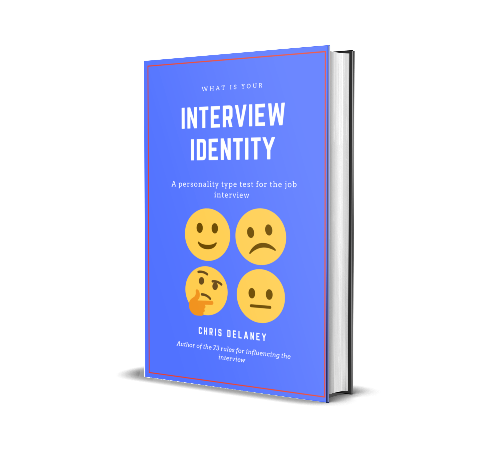
The Interview prediction grid explains how it’s a mixture of perceived experience/qualifications X confident (persuasive) communication that creates a successful interviewee (source: Interview Identity)
Understanding the Rules for a Successful Job Interview
Relevance is king in a job interview.
The biggest mistake experienced career professionals make is discussing experiences that are low on the organisation’s hierarchy of criteria for the advertised position.
For each company, and for each role within the organisation, there is a hierarchy of experiences, skills, knowledge, and qualities that are required for the position being advertised.
Speaking generically, in a structured job interview, each of the hierarchy of criteria will be asked in one of the job interview questions.
If the company values stakeholder management, they may ask, “Give me an example of influencing multiple stakeholders to actively engage them in a multiagency project”.
For a lower-skilled job, where ‘teamwork’ is valued highly, the question may be “Can you share a time you worked successfully within a team?”
Being able to foresee the hierarchy of criteria, therefore predict the interview questions, allows a savvy applicant to rehearse their interview answers.
In a structured job interview, a scoring system is used, where applicants’ answers are graded by being cross-referenced against a list of criteria and/or example answers.
The scoring system is often 1(low) to 4 (high). The interviewee with the highest score, the person who references more of the essential criteria, is offered the role.
Job criteria can be easy to predict. For some roles, finance, as an example, mathematics, and financial knowledge, will be on the hierarchy of criteria.
The company values, mission, and vision will also give clues to how the organisation operates, which links directly to their operational styles.
As an example, the company may be proactive or reactive, innovative or process-driven, and they may be a large corporation or a small family business.
The wording of the interview question also gives clues to the hierarchy of criteria. “Give me an example of influencing multiple stakeholders to actively engage them in a multiagency project,” compared to “give me an example of successfully working with multiple stakeholders.”
Even though the questions are similar, the word “influencing” is key here. The interviewee may discuss stakeholder theory, such as the stakeholder matrix, to explain the reason behind their actions, helping to acquire a higher scoring interview answer.
The key to a successful job interview is only discussing relevant information in your interview answer.
Language influences
Self-promotion is not only key for a successful job interview, but it is also expected.
Research has proven that detailed (relevant) interview answers score higher than simple and short replies.
What is important when selling yourself is the promotional language that is used. Words have power.
Synonyms are important here; imagine your answers use the word ‘good’ to describe your work ethic.
At an emotional level, how does the word ‘good’ feel? If ‘good’ was replaced with ‘strong’, ‘excellent’, ‘outstanding’, ‘brilliant’, or even ‘exceptional’, would this feel better?
Remember, employers often have a ‘gut’ feeling about an applicant, which influences how they score their answers.
A big barrier, often caused by interview anxiety, is the lack of detail given during an interview answer. It’s common for candidates to answer behavioural interview questions (give me an example of…) by saying “yes this is something I have a lot of experience in” or something similar in length. The answer may confirm the required experience, but doesn’t actually say anything.
How much experience? What level of knowledge? What active role did you have? Do you have the underpinning knowledge for this task?
Employers need to know the breadth of an applicant’s experience and knowledge. A strong way to answer behavioural interview questions is with the ‘theory X experience’ interview answer formula.
First, the interviewee discusses the theory behind the job criteria (explaining the stakeholder matrix theory) and then gives a real-life example.
All examples should state the situation (what was being asked of them), actions taken (be specific here), and the positive outcome of the actions taken.
Employers will only know how good you are if you tell them

Confident communication is the icing on the interview answer
People like to hire confident professionals.
We like and admire confidence in others.
Confident communication is powerful in a job interview. If answers are self-promoting and relevant to the job criteria, speaking like a professional orator will add those vital extra points on the interview scorecard.
Public speakers know the value of confident communication and use the following techniques to be viewed as strong speakers:
Pause after each sentence and paragraph – the pause allows the interview panel to catch up (they will be busy scribbling down notes) and shows confidence as nervous people speak quickly without a break, losing the interest of the audience
Reduce filler words (urms and arghs) – filler words are the way your brain fills silences, as anxious people hate silences. But filler words are viewed as an annoying habit, and remove the vital pause that allows the interviewer to listen intently to the applicant’s interview answer
Non-verbal’s are key – smiling, eye contact, and positive gestures add volume to the words spoken. People always use non-verbal’s, even nervous interviewees, but their non-verbal’s highlight fear and weakness (looking away, head down, cold and damp handshake, pulling at imaginary threads)
Rhetoric devices – the use of rhetorical devices embedded into interview answers is an advanced technique. The best orators throughout history use rhetorical devices, as they help residents their story to an audience, influencing them at a subconscious level.
Common rhetorical devices:
- Logos: Appeals to logic and reason, using evidence, statistics, and facts to support an argument.
- Pathos: Appeals to emotion, using strong language, vivid imagery, and stories to connect with the audience on an emotional level.
- Ethos: Appeals to credibility and authority, establishing the speaker or writer as knowledgeable and trustworthy.
- Metaphor: A figure of speech that compares two unlike things without using “like” or “as”.
- Simile: A figure of speech that compares two things using “like” or “as”.
- Hyperbole: Exaggerated statements not meant to be taken literally.
- Alliteration: The repetition of the same sounds or syllables at the beginning of words.
- Anaphora: The repetition of a word or phrase at the beginning of successive clauses.
- Anadiplosis: The repetition of the last word or phrase of a clause at the beginning of the next.
- Antithesis: The contrast of opposing ideas in parallel form.
- Rhetorical question: A question that does not require an answer, used to make a point.
Use the right words to make a big statement
Interview Coaching
Need help? Book an interview coaching session.
Virtual job interview coaching can help you achieve your career dreams:
- Double your salary when you master selling yourself in the job interview
- Enjoy the interview process with increased confidence
- Choose the employer of your choice with multiple job offers